


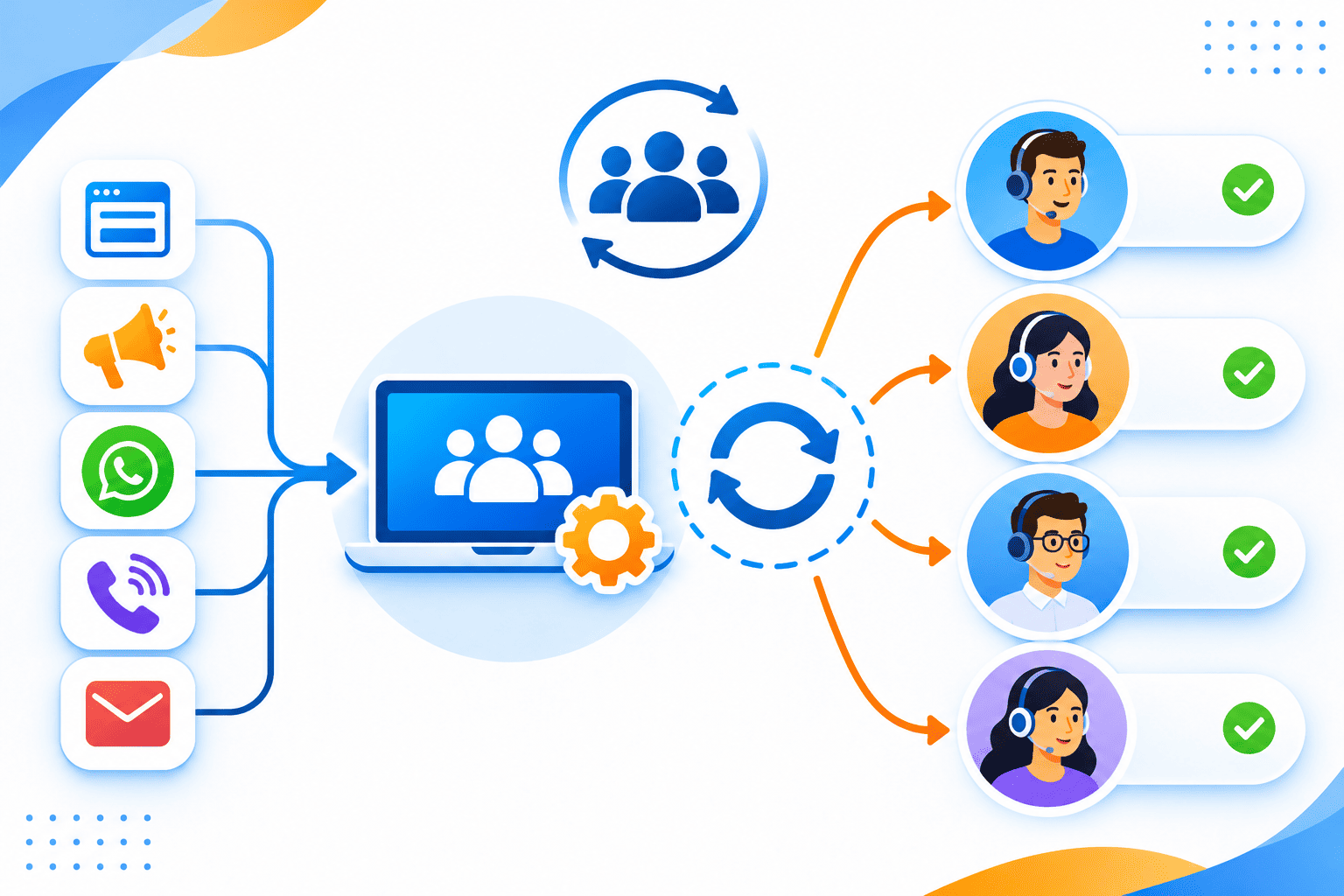
Monday morning, a new Facebook campaign goes live and 200 leads arrive before lunch. At the same time, IndiaMART enquiries keep trickling in. If one salesperson grabs the leads fastest, the rest of the team sits idle and complains, and half the leads wait hours for a call. Round robin lead distribution fixes this by handing leads out in turn, automatically and instantly. But a plain rotation breaks down during real-world lead floods, shift changes and leave days. This guide shows practical setup patterns that keep round robin fair and fast, especially for high-volume sources like Facebook lead ads and IndiaMART.
Table of contents
- How round robin lead distribution works
- Where basic round robin breaks
- Five round robin setup patterns
- Handling Facebook lead floods
- Handling IndiaMART enquiries
- Handling duplicates, returning leads and junk
- Measuring fairness and speed
- A hypothetical example
- How Wetroo helps
- FAQs
- Conclusion
How round robin lead distribution works
In its simplest form, leads are assigned in strict rotation:
| Lead | Assigned to |
|---|---|
| 1 | Asha |
| 2 | Bilal |
| 3 | Chitra |
| 4 | Asha |
| 5 | Bilal |
Everyone gets an equal share, decisions are transparent, and nobody needs to forward leads manually. The CRM remembers who is next, and the assigned person gets an instant alert. If you are deciding between rotation and other routing models, see our comparison of lead assignment rules.
Where basic round robin breaks
- Leave and shifts. A lead assigned to someone off duty waits until they return.
- Uneven capacity. A senior closer and a trainee get the same volume.
- Lead floods. A campaign spike piles dozens of leads on each person at once, and the later leads in each person's queue go cold.
- Quality variance. Rotation can give one person several junk leads in a row by chance.
- Duplicate leads. The same person submitting twice can land with two different salespeople.
Five round robin setup patterns
Pattern 1: Availability-aware round robin
Only people marked available (on shift, not on leave) are in the rotation. Essential for teams with shifts or field visits.
Pattern 2: Weighted round robin
Assign weights: a senior gets 2 leads for every 1 a trainee gets. Useful when experience levels differ.
Pattern 3: Capped round robin
Each salesperson has a cap on open, uncontacted leads. When they hit the cap, they are skipped until they work their queue. This protects response time during floods.
Pattern 4: Round robin within teams
First route by source, language or territory to a team, then rotate within it. This combines fairness with fit.
Pattern 5: Round robin with reassignment
If a lead is not contacted within a set time (say 10 minutes), it is reassigned to the next person, and the manager is alerted.
Choosing your pattern
| Situation | Recommended pattern |
|---|---|
| Small team, similar skills, steady volume | Basic or availability-aware |
| Mixed seniority | Weighted |
| Frequent campaign spikes | Capped + reassignment |
| Multiple languages or regions | Within teams |
| Response time problems | Reassignment SLA |
Handling Facebook lead floods
Facebook and Instagram lead ads can generate large volumes quickly, especially on the first days of a campaign.
Setup checklist for campaign spikes
- Connect lead forms directly to the CRM so leads arrive in real time
- Turn on availability-aware rotation, and confirm everyone's status before launch
- Set a cap on uncontacted leads per person
- Add a 10–15 minute reassignment rule
- Send an instant WhatsApp acknowledgement to every lead, so nobody waits in silence
- Consider an AI agent for first qualification outside working hours
- Deduplicate by phone number before assignment
- Watch the dashboard in the first hours of a campaign and adjust caps
Also remember that lead ad leads should be downloaded or synced promptly; relying on manual exports introduces delays that rotation cannot fix.
Tip: brief the team before launch
Tell the team when a campaign goes live, what the ad promised and what the first question should be. Round robin distributes the leads; preparation converts them. For a complete Facebook setup, see our guide to Facebook lead ads CRM.
Handling IndiaMART enquiries
IndiaMART enquiries tend to arrive steadily rather than in bursts, but they are often B2B, product-specific and time-sensitive because buyers contact several suppliers. IndiaMART provides CRM integration through Pull and Push APIs for paid sellers, as described in its help centre.
Recommended pattern
- Route IndiaMART leads to a dedicated B2B team
- Within that team, use round robin by product category if reps specialise
- Use weighted rotation if a senior handles bulk orders
- Send a quick WhatsApp or SMS acknowledgement with your catalogue
- Set a tight reassignment SLA, because competing suppliers respond quickly
For more, see our guide to IndiaMART leads automation.
Handling duplicates, returning leads and junk
Rotation works only if the leads entering it are clean.
Duplicates
Before assignment, check whether the phone number already exists. If it does, return the lead to its existing owner instead of rotating it, so the customer does not get calls from two people.
Returning leads
When an old lead enquires again months later, decide whether it goes back to the original owner (continuity) or into rotation (fairness). Many teams return it to the original owner if they are still active.
Junk and test leads
Mark obviously invalid leads (wrong numbers, test submissions) so they do not count against a salesperson's share. Some teams credit the person with a replacement lead to keep rotation fair.
Measuring fairness and speed
Track these each week:
- Leads per person vs expected share (accounting for weights)
- Median time to first contact by person
- Reassignment rate: frequent reassignment for one person signals a capacity or discipline issue
- Conversion by person: fair distribution makes this comparison meaningful
- Lead quality by source: if one source sends many junk leads, fix targeting rather than rotation
Review these numbers with the team in a short weekly huddle rather than only in management meetings. Sharing these numbers openly builds trust in the system and ends the "he got all the good leads" debate.
A hypothetical example
Illustrative scenario, not a real business.
An education loan consultancy in Indore runs Facebook campaigns around admission season. On launch days, leads arrive in large bursts. Earlier, the manager forwarded leads in batches on WhatsApp, and some waited hours.
The consultancy switches to capped, availability-aware round robin. Each counsellor can hold up to 10 uncontacted leads; when they reach that cap, the system skips them. Any lead not contacted in 10 minutes is reassigned. Every lead receives an instant WhatsApp acknowledgement in Hindi or English. The manager watches a live dashboard on launch days, and counsellors stop arguing about who got which leads, because the distribution is visible to everyone.
How Wetroo helps
Wetroo captures leads from Facebook Ads, Instagram, Google Ads lead forms, IndiaMART, WordPress forms and 100+ integrations, and routes them through teams and sub-teams with custom assignment rules. Assigned salespeople receive instant alerts on the app and by email and can respond with one-touch Quick Response on WhatsApp, SMS or email.
Wetroo's AI agents can chat, call and qualify leads 24/7, which helps during floods or after hours. The analytics dashboard shows lead source performance and team activity, and an implementation manager on every plan can help you configure your rotation.
FAQs
What is round robin lead distribution?
A method of assigning new leads to salespeople in turn, so each person receives an equal or weighted share automatically.
Is round robin fair if salespeople have different skills?
Use weighted rotation, or route by skill or territory to a team first and rotate within it.
What happens when a salesperson is on leave?
With availability-aware rotation, they are skipped until they are marked available again.
Should duplicate leads go into the rotation?
Usually not. Return duplicates to the existing owner so the customer deals with one person.
How do I handle sudden lead spikes?
Combine caps on uncontacted leads, reassignment SLAs, instant acknowledgements and AI-assisted qualification.
Conclusion
Round robin lead distribution is the simplest way to make lead allocation fast and fair, but real teams need more than a plain rotation. Add availability, weights, caps and reassignment rules, route by team where fit matters, and prepare specifically for Facebook campaign spikes and IndiaMART enquiries. Measure fairness and speed openly. To set up automatic, fair lead routing for your team, explore www.wetroo.com.



