


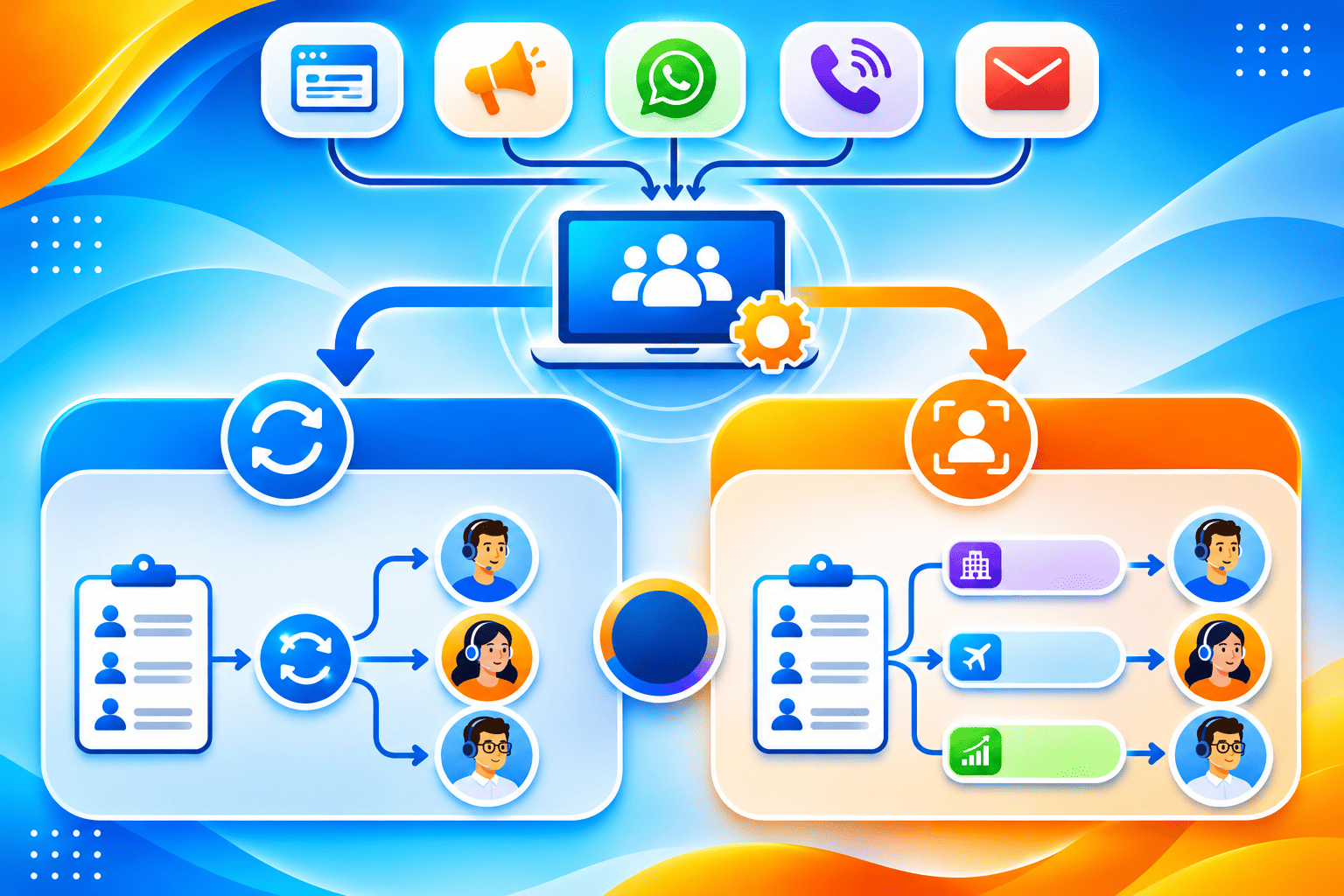
When a new lead arrives, the first question is simple: who calls? In many Indian SMBs the answer is "whoever sees it first" or "the manager will forward it". Both approaches create delays, disputes and missed leads. Lead assignment rules answer the question automatically and fairly, the moment a lead lands. The two most common models are round robin, which shares leads evenly, and skill-based routing, which matches leads to the best-suited person. This guide compares them, along with territory, source and value-based rules, and shows how to combine them for your team.
Table of contents
- Why lead assignment rules matter
- The main types of lead assignment rules
- Round robin vs skill-based: a comparison
- Combining rules with teams and sub-teams
- How to set up lead assignment rules
- A hypothetical example
- How Wetroo helps
- FAQs
- Conclusion
Why lead assignment rules matter
- Speed. Leads go cold quickly. Harvard Business Review's study of online sales leads found most companies are not responding nearly fast enough. Automatic assignment removes the manual forwarding step. See our guide on speed to lead.
- Fairness. Salespeople trust a system that distributes opportunities transparently.
- Accountability. Every lead has exactly one owner.
- Fit. The right lead reaches the right person: language, product or location.
- Less leakage. Unassigned leads are the most common source of lead leakage.
The main types of lead assignment rules
Round robin
Leads are distributed in turn: A, B, C, A, B, C. Simple, fair and easy to explain. Variants include weighted round robin (senior reps get more) and availability-aware round robin (skip people on leave or off shift).
Skill-based
Leads are routed by attributes matched to salesperson skills: language (Hindi, Tamil, Marathi), product line (home loans vs personal loans), deal type (B2B vs retail) or experience level.
Territory-based
Leads go to the person or team covering their city, pin code or state. Common in real estate, distribution, field sales and franchise businesses.
Source-based
Leads from a particular source go to a specific team: IndiaMART enquiries to the B2B desk, Instagram leads to the D2C team, referral leads to senior closers.
Value-based
High-value leads (large budget, bulk quantity, premium product) go to senior salespeople; smaller leads to juniors or an AI agent for initial qualification.
Round robin vs skill-based: a comparison
| Factor | Round robin | Skill-based |
|---|---|---|
| Setup effort | Low | Medium |
| Fairness perception | High | Depends on transparency |
| Lead–rep fit | Random | High |
| Data needed | None | Lead attributes (language, product, city) |
| Best for | Uniform leads, similar reps | Diverse leads, specialised reps |
| Risk | Mismatched language or product | Overloading top specialists |
| Typical example | Single-product coaching institute | Multi-language NBFC or multi-city builder |
When to use round robin
Your leads are broadly similar, your salespeople have comparable skills, and fairness is a priority. For setup patterns during lead floods from Facebook or IndiaMART, see our guide to round robin lead distribution setup.
When to use skill-based routing
Your leads vary by language, product or deal size, and a mismatch costs conversions, for example a Tamil-speaking customer reaching a Hindi-only salesperson.
Combining rules with teams and sub-teams
Most growing businesses use a hybrid: a first rule picks the team, a second distributes within it.
Example structure:
- Level 1 (team): by source or territory
- IndiaMART → B2B team
- Facebook/Instagram → Retail team
- Google Ads → Retail team
- Level 2 (sub-team): by skill
- Retail team → Hindi sub-team or South Indian languages sub-team, by the lead's state
- Level 3 (person): round robin within the sub-team, skipping anyone on leave
Fallback and escalation rules
- If no one in the sub-team is available, assign to the team lead
- If a lead is not contacted within a set time, reassign or alert the manager
- If a lead is reopened, return it to the original owner where possible
How to set up lead assignment rules
Step 1: Audit your leads
List your lead sources, cities, languages and products for the last few months. Identify where mismatches happened.
Step 2: Map your team
Record each salesperson's languages, products, territories, shifts and capacity.
Step 3: Choose the primary model
Start simple. Round robin within teams is a good default; add skill or territory rules where mismatches are costly.
Step 4: Define fallbacks and SLAs
Decide what happens when nobody matches, and how quickly a lead must be contacted before reassignment.
Step 5: Test with sample leads
Push dummy leads with different attributes and confirm each lands with the right person.
Step 6: Review monthly
Look at conversion and response time by rule, team and person. Adjust weights and rules as your team changes.
Assignment rules checklist
- Every source maps to a team
- Every team has a distribution method
- Leave and shift handling in place
- Fallback owner defined
- Reassignment SLA set
- Instant alert to the assigned person
- Monthly review scheduled
Mistakes to avoid
- Too many rules on day one. Complex routing is hard to debug. Add rules only when data shows a mismatch problem.
- Hidden logic. If salespeople don't understand why leads go where they do, they assume favouritism. Publish the rules internally.
- Ignoring capacity. A skill-based rule that sends every Tamil lead to one person will overload them. Add a backup in each skill group.
- No reassignment. A lead assigned to someone who never calls is still a lost lead. Pair assignment with response-time SLAs.
- Set and forget. Teams change, people join and leave, and new sources appear. Review rules whenever the team changes.
A hypothetical example
Illustrative scenario, not a real business.
A health insurance agency in Hyderabad gets leads from Facebook ads across Telangana, Andhra Pradesh, Karnataka and Maharashtra. With pure round robin, Telugu-speaking leads often reached Marathi-speaking agents and vice versa, and conversations stalled.
The agency moves to a hybrid model. Leads are first routed by state to language-specific sub-teams, then distributed by round robin within each sub-team, with senior agents receiving more leads for family floater enquiries above a set sum insured. A fallback sends unmatched leads to the team lead, and anything not contacted within 10 minutes triggers a manager alert. Agents see fewer mismatched conversations, and the manager can compare sub-team performance on one dashboard.
The point of the example is that good assignment rules are layered rather than clever. Match leads by language or region first, share them fairly within each group, keep a fallback for anything unmatched and alert a manager when speed slips. That combination covers most real-world situations an Indian sales team faces.
How Wetroo helps
Wetroo lets you create teams and sub-teams and set custom assignment rules, so leads from Facebook Ads, Instagram, Google Ads lead forms, IndiaMART, WordPress forms and other integrations are routed automatically to the right owner. Assigned salespeople get instant alerts through the app and email, and can reply in one touch on WhatsApp, SMS or email.
Role-based access, lead tagging and filters support skill or territory routing, and the analytics dashboard shows performance by team and salesperson. Wetroo's onboarding includes an implementation manager on every plan to help configure your rules.
FAQs
What are lead assignment rules?
Automated rules in a CRM that decide which salesperson or team receives each new lead, based on criteria like rotation, skill, territory, source or value.
Is round robin or skill-based routing better?
Round robin is simpler and feels fair; skill-based routing improves fit. Many teams combine them: route by skill or territory to a team, then round robin within it.
How do I handle salespeople on leave?
Use availability-aware rules that skip unavailable people, and define a fallback owner.
Can AI agents be part of lead assignment?
Yes. Some teams route after-hours or low-intent leads to an AI agent for first qualification, then hand qualified leads to a human owner.
Should high-value leads go to senior salespeople?
Often yes, through value-based rules or weighted distribution, but monitor workload so seniors are not overloaded.
Conclusion
Clear lead assignment rules give every lead an owner within seconds, improve fairness and match customers with the right salesperson. Start with round robin, add skill, territory, source or value rules where they make a real difference, and always define fallbacks and SLAs. Review the results monthly and adjust as your team grows. To set up automated routing for your teams and sub-teams, explore www.wetroo.com.



