


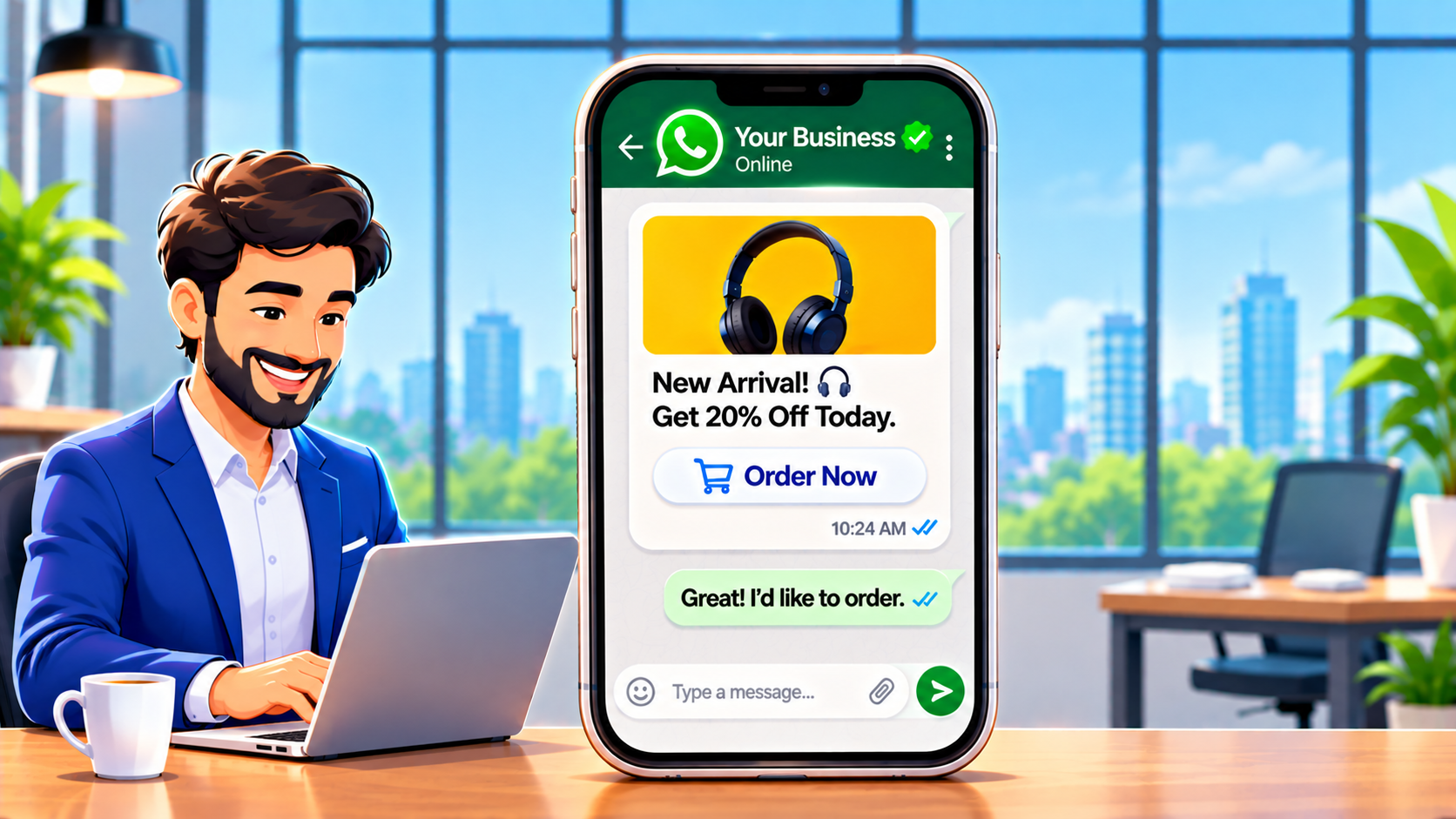
Ask a small business owner in India where their customers actually reply, and the answer is almost always WhatsApp. Emails sit unopened and SMS feels like OTP territory, but a WhatsApp message from a shop you trust gets read. That is exactly why WhatsApp marketing works, and also why it can backfire. Send too much, send without permission, or send the wrong thing, and customers block you, which hurts your number's quality and your brand. This playbook lays out a simple, repeatable system for Indian SMBs: earn opt-in, use templates well, respect the 24-hour window, and automate sequences that feel personal. Every example is from an Indian business context.
Table of contents
- What WhatsApp marketing is (and is not)
- Step 1: Build an opt-in list the right way
- Step 2: Understand templates and the 24-hour window
- Step 3: Plan campaigns by funnel stage
- Step 4: Automate sequences instead of blasting
- Step 5: Measure what matters
- A hypothetical example: a Pune bakery chain
- How Wetroo helps
- FAQs
- Conclusion
What WhatsApp marketing is (and is not)
WhatsApp marketing is using WhatsApp to start and continue conversations that lead to sales: announcing a launch, reminding a lead about a demo, sharing a festive offer, or bringing back a customer who has not ordered in months.
It is not forwarding the same poster to every number in your phone. On the official WhatsApp Business Platform, outbound marketing uses approved templates sent to people who agreed to hear from you. That structure is a feature, not a restriction: it keeps your messages welcome and your number healthy.
Step 1: Build an opt-in list the right way
Opt-in means the customer agreed to receive WhatsApp messages from your business. Simple, honest ways to collect it in India:
- Lead forms on Facebook, Instagram or Google Ads with a clear line such as "We'll send details on WhatsApp."
- Click-to-WhatsApp ads where the customer messages you first.
- Website chat buttons and QR codes on packaging, billing counters and visiting cards.
- At checkout or billing: "Would you like your bill and offers on WhatsApp?"
- IndiaMART and marketplace enquiries, followed by a first message asking whether WhatsApp is fine for updates.
Record where each opt-in came from. It helps you segment later and shows good faith if anyone asks.
Step 2: Understand templates and the 24-hour window
Meta's developer documentation describes two modes of messaging on the platform:
- Inside the 24-hour customer service window. When a customer messages you, a 24-hour window opens and resets with each new customer message. During it, you can send free-form replies: text, images, catalogues, voice notes.
- Outside the window. You can only start conversations with pre-approved templates, which fall into marketing, utility or authentication categories.
This shapes your whole playbook. Campaigns that make customers reply put you back inside the window, where real selling happens. A template that ends with a question ("Shall I share the price list?") usually performs better than one that ends with a full stop.
At the time of writing, Meta charges per delivered message, and marketing templates cost more than utility ones in India. Plan accordingly; our template approval tips explain categories in more depth.
Step 3: Plan campaigns by funnel stage
| Funnel stage | Goal | Example message idea (India) | Template type |
|---|---|---|---|
| New lead | Fast first contact | "Hi Ankit, thanks for your enquiry about the 2BHK in Wakad. Can I send the floor plan?" | Utility or marketing, depending on content |
| Considering | Build trust | Customer review video, site-visit slots, demo class invite | Marketing |
| Ready to buy | Remove friction | Quotation, payment link, delivery date | Utility or service |
| Customer | Delight | Order update, care tips, invoice | Utility |
| Lapsed | Win back | "It's been three months since your last service. Book this week and get free pickup." | Marketing |
Keep a calendar. For most SMBs, one or two marketing messages per month per segment is plenty, plus utility messages as needed.
Festive and seasonal moments
India's calendar gives you natural reasons to message: Diwali, Navratri, Eid, Pongal, Onam, Christmas, year-end sales, admission season and wedding season. Plan offers two to three weeks ahead and segment by region, since Onam matters more in Kochi than in Kanpur.
Step 4: Automate sequences instead of blasting
A sequence is a planned series of messages triggered by a customer's action or inaction. For example, a new lead who does not reply:
- Minute 0: Welcome message with one useful link or attachment.
- Day 1: Short follow-up with a question.
- Day 3: Social proof, such as a customer video or photos.
- Day 7: Soft close: "Should I keep this enquiry open for you?"
The moment the lead replies, the sequence should stop and a human should take over. Read more in our guide to WhatsApp drip campaigns.
Personalise without being creepy
Use the customer's name, the product they asked about and their city. Avoid referencing things they did not share with you directly.
Step 5: Measure what matters
Delivery and read counts are nice, but they do not pay salaries. Track:
- Reply rate by template and segment
- Leads contacted within 10 minutes
- Conversations that became quotes, visits or orders
- Cost per conversion, combining ad spend and message charges
- Block and opt-out signals, which warn you that frequency or content is off
Quick WhatsApp marketing checklist
- Every contact has a recorded opt-in source
- Templates end with a clear, single call to action
- Segments are defined by interest, stage or location
- Sequences stop when a lead replies
- A human responds within the 24-hour window
- Results are reviewed weekly, not just sends
A hypothetical example: a Pune bakery chain
Illustrative scenario, not a real business.
A bakery with four outlets in Pune collects WhatsApp opt-ins at billing for custom cake orders. It segments customers into "birthday cakes", "office orders" and "festive hampers".
Two weeks before Diwali, it sends a marketing template with a hamper catalogue only to the festive and office segments, ending with "Reply HAMPER to see this year's boxes." Replies open the service window, a staff member shares prices and a payment link, and a utility message confirms the pickup slot. Customers who do not reply get one reminder five days later, and nothing more. The owner tracks orders per segment rather than total messages sent, and plans next year's list based on which segment converted.
How Wetroo helps
Wetroo gives SMBs the official WhatsApp Business API inside a CRM, so marketing and sales stay connected. Leads from Facebook Ads, Instagram, Google Ads lead forms, IndiaMART and WordPress forms sync automatically, and the Quick Response feature sends a personalised WhatsApp introduction in one touch. Lead tagging, search and filters let you build segments, while broadcasting and retargeting reach opted-in contacts.
For automation, Wetroo offers sales sequences, drip campaigns and rule-based workflows, plus AI agents that chat, qualify and follow up around the clock with handover to your team. A chatbot builder supports English, Hindi, Marathi, Tamil, Telugu, Bengali, Gujarati and Kannada, which helps when your customers prefer their own language.
FAQs
Is WhatsApp marketing legal in India?
Using the official WhatsApp Business Platform with opted-in customers and approved templates is the supported route. Follow WhatsApp's policies and any sector rules that apply to you.
How often should I send WhatsApp marketing messages?
For most SMBs, one or two marketing messages per month per segment is a sensible starting point. Watch replies and blocks, and adjust.
Can I send WhatsApp marketing messages to people who have not saved my number?
On the official API, yes, provided they have opted in and you use approved templates. The Business app's broadcast lists only reach people who saved your number.
What is the best time to send?
Test it. Many Indian businesses see better replies in late morning or evening, but your audience may differ.
Conclusion
Effective WhatsApp marketing is less about volume and more about permission, timing and conversation. Build an honest opt-in list, use templates that invite replies, sell inside the 24-hour window, automate sequences that stop when people respond, and measure conversions rather than sends. Do that consistently and WhatsApp becomes your most reliable sales channel. To run this playbook from one CRM built for Indian SMBs, start at www.wetroo.com.



