


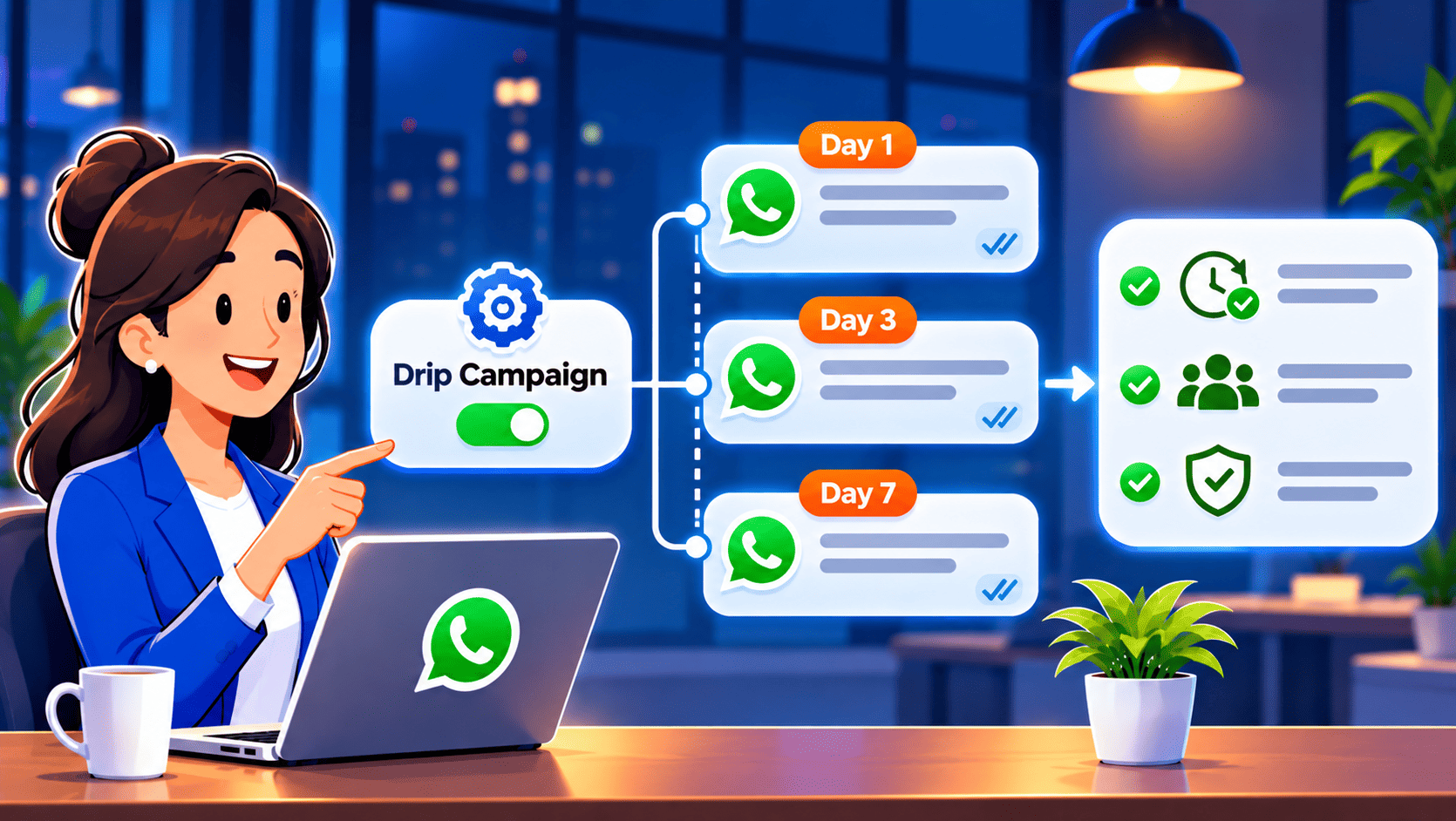
Most leads do not buy on the first conversation. A parent wants to compare three coaching centres, a home buyer waits for a bonus, a factory buyer needs approval from the owner. The business that stays politely present over those days usually wins. A WhatsApp drip campaign does exactly that: it sends a short series of helpful messages over time, triggered by what each lead does, so nobody is forgotten and nobody is bombarded. This guide explains how a drip differs from a broadcast, how to design one that feels personal rather than spammy, and how to set stop rules so humans step in at the right moment.
Table of contents
- Drip vs broadcast: not the same thing
- Anatomy of a good WhatsApp drip campaign
- Timing and frequency for Indian buyers
- Stop rules: the part most teams forget
- Three sample drip sequences
- A hypothetical example
- How Wetroo helps
- FAQs
- Conclusion
Drip vs broadcast: not the same thing
| Broadcast | Drip campaign |
|---|---|
| Who receives it | A whole segment at once |
| When | One moment you choose |
| Content | Same message for everyone |
| Goal | Announce something |
| Ends when | It is sent |
A broadcast says, "Our Diwali offer is live." A drip says, "Hi Neha, it's been two days since you asked about the 1-year MBA prep course. Here's a five-minute video from our faculty. Want me to book a demo class?" Both have a place. Drips do the quiet, steady work of follow-up.
Anatomy of a good WhatsApp drip campaign
A clear trigger
Every drip starts with an event: a new lead from a Facebook form, a quotation sent, a demo missed, a cart abandoned, a customer due for renewal.
A defined goal
One drip, one goal. "Book a site visit" or "get the quotation approved", not both.
Three to five messages
Each message should add something: information, proof, a reason to act now, or an easy way out.
Approved templates
Outside the 24-hour customer service window, the official WhatsApp Business Platform only allows pre-approved template messages, as Meta's pricing and messaging documentation explains. Every drip step after the first day will usually be a template. See our tips on writing approvable templates.
Personal variables
Name, product, city, date of enquiry and the salesperson's name make an automated message feel like a human one.
Exit conditions
The rules that stop the drip. We cover these below because they matter most.
Timing and frequency for Indian buyers
There is no universal schedule, but these principles work for most SMBs:
- First message immediately after the trigger, ideally within minutes.
- Second touch within 24 hours, while the lead still remembers you.
- Then space out: day 3, day 7, day 14.
- Respect hours. Avoid early mornings and late nights unless the customer started the conversation then.
- Respect festivals and context. Pause sales nudges on days people are busy with family, and use festive periods for relevant offers instead.
- Mix channels thoughtfully. A WhatsApp message plus a phone call often beats five WhatsApp messages.
Our guide to the sales follow-up process shows how to combine WhatsApp with calls and SMS.
Stop rules: the part most teams forget
A drip that keeps sending after a lead has replied is the fastest way to look like a robot. Build these exits into every campaign:
- Lead replies: stop the drip and alert the assigned salesperson.
- Lead converts: stop sales messages and switch to onboarding or utility messages.
- Lead opts out: stop all marketing immediately and record it.
- Salesperson changes the stage manually: stop or switch to the drip for the new stage.
- No engagement after the last step: move the lead to a long-term nurture list with low frequency.
These rules are what separate a WhatsApp drip campaign from spam.
Three sample drip sequences
1. New enquiry, no reply (education)
- Minute 0: "Hi {{name}}, thanks for asking about {{course}} at {{institute}}. Here's the batch schedule. Is a weekday or weekend batch better for you?"
- Day 1: "Hi {{name}}, many students ask about fees and EMI options for {{course}}. I can share the breakdown. Shall I?"
- Day 3: "Here's a short video of a demo class for {{course}}. Would you like to attend the next one free?"
- Day 7: "Hi {{name}}, should I keep your enquiry open, or would you like me to close it for now?"
2. Quotation sent, no response (B2B)
- Day 1: "Dear {{name}}, sharing the quotation for {{product}} again for easy reference. Any questions on specs or delivery?"
- Day 4: "Many buyers in {{city}} also ask about bulk pricing. If quantity changes, I can revise the quote."
- Day 10: "Just checking whether {{company}} has finalised this requirement. Happy to help if anything is pending."
3. Missed site visit (real estate)
- Same day: "Hi {{name}}, we missed you at {{project}} today. Would you like to reschedule this week?"
- Day 2: "Here's a 60-second walkthrough of the sample flat at {{project}}."
- Day 6: "Weekend slots at {{project}} are filling. Shall I hold one for you?"
Remember to choose the right template category for each message: reminders tied to something the lead requested are often utility, while nudges and offers are marketing.
How to measure a drip
Look at each step separately rather than the campaign as a whole. Useful questions: which message gets the most replies, at which step do leads opt out, and how many leads reach the goal (a booked visit, an approved quote) within 14 days. If one step consistently produces opt-outs, rewrite or remove it. If most replies come at day 1, consider adding a phone call at that point. Small, regular edits beat a big redesign every quarter.
A hypothetical example
Illustrative scenario, not a real business.
A solar installer in Ahmedabad gets about 300 Facebook leads a month. Salespeople call each lead once, and anyone who does not pick up is effectively forgotten.
The owner sets up a drip: an instant WhatsApp welcome with a rooftop solar explainer, a day-1 message about the government subsidy process with a link to the official portal, a day-3 customer installation video and a day-7 "should I keep this open?" message. The drip stops the moment a lead replies, and the assigned salesperson gets an alert to call. After a month, the owner sees which step gets the most replies and rewrites the weakest one.
How Wetroo helps
Wetroo includes drip campaign automation and sales sequences alongside the official WhatsApp Business API, so your follow-ups run from the same CRM where leads arrive. Leads from Facebook Ads, Instagram, Google Ads lead forms, IndiaMART and WordPress forms can trigger sequences automatically, and rule-based workflows plus a no-code workflow builder let you set conditions and exits.
When a lead replies, the conversation appears in Wetroo's omnichannel inbox, assigned by your custom rules, and follow-up reminders on the Android and iOS apps prompt the salesperson to act. Sequences can also include SMS and email, so WhatsApp does not have to do all the work.
FAQs
What is a WhatsApp drip campaign?
It is an automated series of WhatsApp messages sent to each lead over time, triggered by their actions, and stopped when they reply or convert.
How many messages should a drip include?
Three to five is usually enough for one goal. More than that risks annoying the lead.
Do drip messages need template approval?
Messages sent outside the 24-hour customer service window must use approved templates on the official platform.
Can I run drip campaigns on the WhatsApp Business app?
The app has no built-in drip automation. Drips generally require the official API and a CRM or automation tool.
Conclusion
A well-designed WhatsApp drip campaign is the polite, persistent salesperson every SMB wishes it had: present at the right moments, helpful every time, and quiet the second a human should take over. Start with one trigger, one goal and four messages, build strict stop rules, and review reply rates every month. To run drips from the same CRM that captures your leads, explore www.wetroo.com.



