


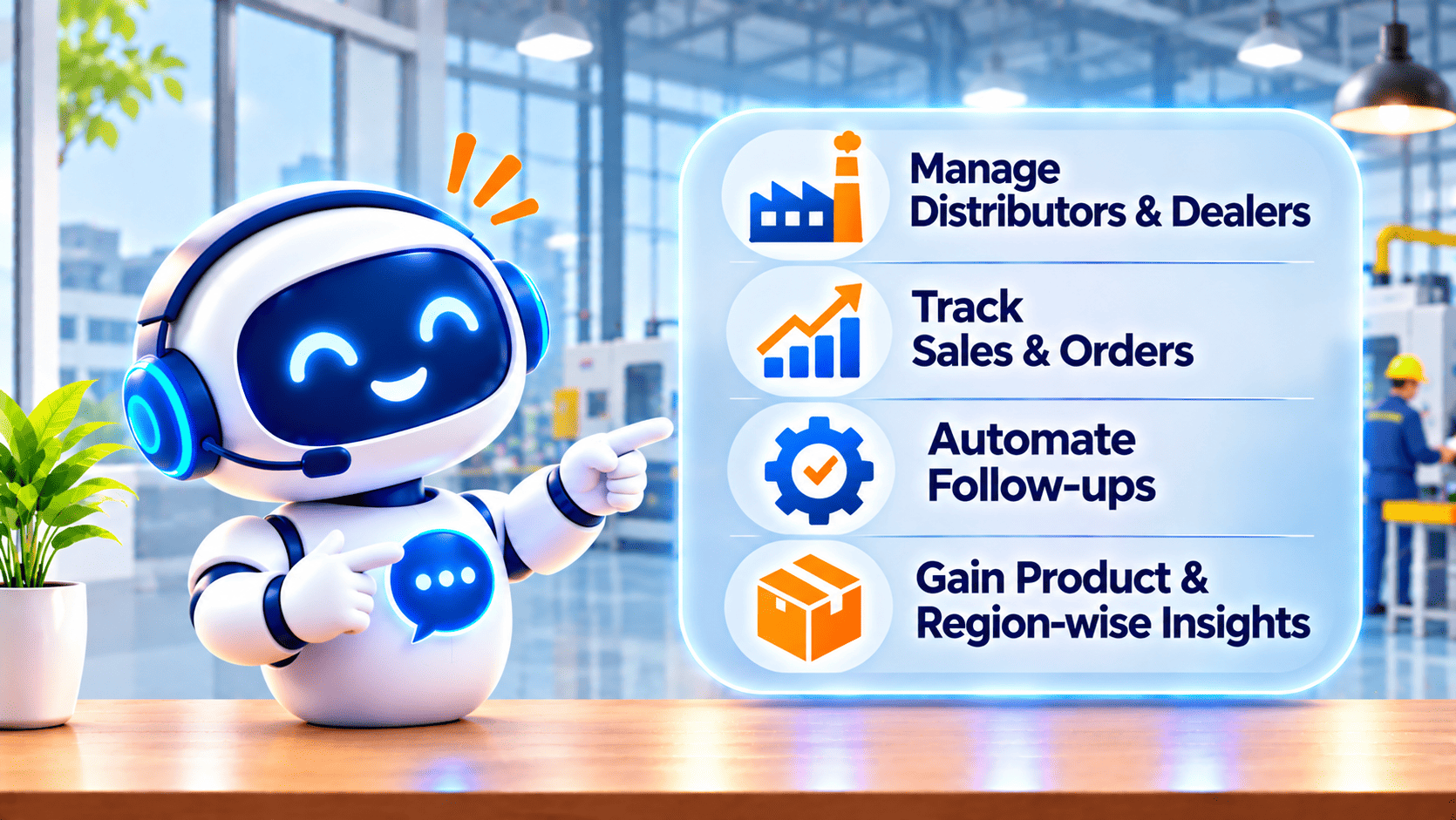
An Indian manufacturer's sales team often runs two businesses at once. One is the distributor and dealer network: regular orders, schemes, outstanding payments and monthly targets. The other is direct enquiries: a buyer on IndiaMART wanting 5,000 units, an OEM asking for a custom specification, a contractor who saw your stall at an exhibition. Both arrive on the same phones and email inboxes, and both get handled from Excel and memory. A CRM for manufacturing sales brings distributor relationships and direct enquiries into one system, so nothing falls between the cracks. This guide explains how to set it up for Indian manufacturing businesses.
Table of contents
- The two sales engines of a manufacturer
- What a CRM for manufacturing sales should do
- Handling direct enquiries without leakage
- Managing distributors and dealers
- Quotations, samples and long B2B cycles
- How Wetroo helps
- FAQs
- Conclusion
The two sales engines of a manufacturer
Distributor and dealer network
Distributors and dealers buy repeatedly, carry inventory and serve local markets. The sales team's job is relationship management: placing orders, running schemes, resolving complaints, chasing payments and expanding into new territories.
Direct enquiries
These come from IndiaMART and other B2B marketplaces, the website, Google ads, exhibitions, referrals and tenders. They range from one-time bulk buyers to potential OEM partners. Speed and accurate quotations decide who wins.
When both engines share the same people and tools without structure, distributor work (which is urgent and familiar) crowds out new enquiries, and big opportunities quietly go cold.
What a CRM for manufacturing sales should do
| Need | CRM capability |
|---|---|
| Capture direct enquiries | IndiaMART, website, ads and exhibition leads synced automatically |
| Route by product or region | Assignment rules by product line, territory or account size |
| Account records | Distributors, dealers and key customers with contacts and history |
| Quotation tracking | Quotes, revisions and validity dates linked to each opportunity |
| Follow-up discipline | Reminders and sequences for quotes and samples |
| Communication | WhatsApp, email, SMS and calls logged on one timeline |
| Field sales | Mobile app for visits, notes and follow-ups |
| Visibility | Dashboard of enquiries, quotes, conversions and team activity |
The Ministry of MSME (msme.gov.in) supports many small manufacturers, and most of them share a familiar constraint: small sales teams covering wide territories. A CRM helps these teams do more with the same headcount.
Handling direct enquiries without leakage
Connect marketplace and website leads
If you rely on IndiaMART, connect it through an API rather than downloading spreadsheets. IndiaMART's help centre describes its Leads API for delivering inquiries to external CRMs (IndiaMART Help). Our guide to the IndiaMART leads API explains Pull and Push options.
Route by product line
A manufacturer of pumps, motors and valves may have specialists for each. Route enquiries by product keyword or form field, and by region where you have territory managers.
Respond fast with a qualifying message
Send a WhatsApp introduction with the catalogue and ask the key questions: quantity, specification, delivery location, timeline and GST details. A fast, informed first response often decides whether you make the buyer's shortlist.
Qualify before quoting
Not every enquiry deserves a detailed quotation. Use a simple qualification check so engineers spend time on real opportunities. Our guide to B2B lead management covers qualification in more depth.
Managing distributors and dealers
Treat each distributor as an account with its own record.
Distributor management checklist
- Account record with territory, contacts, credit terms and product lines
- Order and enquiry history logged on the timeline
- Scheme and price-list updates broadcast on WhatsApp to opted-in partners
- Visit plans and notes from field sales logged in the mobile app
- Complaints and service issues tracked to closure
- Payment follow-up reminders where your CRM supports it
- Monthly review of each distributor's activity and growth
Passing direct enquiries to distributors
Sometimes a direct enquiry should be served by a local distributor. Share the lead with that distributor, keep your territory manager as the owner and track the outcome, so you know whether distributors act on the leads you pass them.
Quotations, samples and long B2B cycles
Manufacturing deals often move through technical discussions, samples, trials and negotiations.
A practical pipeline for direct B2B enquiries
- New enquiry
- Qualified (requirement and quantity confirmed)
- Technical discussion / drawing review
- Sample or trial
- Quotation sent
- Negotiation
- PO received / Lost (with reason)
Attach drawings, specifications and test reports to each opportunity. Track quotation versions and validity dates. Set reminders so every quotation is followed up at sensible intervals; our guide to quotation follow-up emails has templates.
Hypothetical example
This is a hypothetical example, not a real customer. "Shakti Polymers", an injection-moulding manufacturer in Rajkot, sells through 30 distributors across Gujarat and Maharashtra and receives direct enquiries from IndiaMART and an annual exhibition. Earlier, distributor orders dominated the sales team's day, and IndiaMART enquiries were checked once a day. The company connects IndiaMART to its CRM, routes enquiries by product line and sends an instant WhatsApp introduction with the catalogue. Quotations are tracked with validity dates and follow-up reminders. Distributors have account records, and scheme updates go out as broadcasts to opted-in partners. When a direct enquiry comes from a distributor's territory, it is shared with that distributor and tracked. Management now sees, side by side, distributor activity and the direct enquiry pipeline.
Exhibitions and trade fairs
Exhibition leads should be entered on the same day, tagged by event and followed up within a week. A simple mobile form or business-card capture routine prevents the familiar box of visiting cards that nobody calls.
Common mistakes when manufacturers adopt a CRM
- Importing everything at once. Years of old spreadsheets full of duplicates make the new system look messy on day one. Import active distributors and the last few months of open enquiries first; archive the rest.
- Making it a reporting tool only. If salespeople see the CRM as a way for management to watch them, they will update it late. Show them how alerts, reminders and quick WhatsApp replies save them time.
- Ignoring the field team. Territory managers spend most of their day travelling. If the mobile app is not set up and explained, field activity will never reach the CRM.
- No owner for lead sources. Someone must check weekly that IndiaMART, the website and ad forms are still syncing correctly.
- Skipping lost reasons. Without them, you never learn whether you lose on price, specification, delivery time or slow response.
How Wetroo helps
Wetroo lists manufacturing and B2B among the industries it serves. Its verified features support both sales engines:
- Lead capture from IndiaMART, Facebook Ads, Instagram, Google Ads lead forms and WordPress forms, with 100+ integrations and webhooks.
- Instant lead alerts and one-touch Quick Response intros on WhatsApp, SMS or email.
- Teams, sub-teams and custom assignment rules to route by product line or territory, plus user roles.
- Share leads by email with people who don't have a Wetroo account, useful for passing enquiries to distributors.
- Invoices and quotations created and tracked in the platform.
- WhatsApp Business API with broadcasting and retargeting for scheme and price-list updates to opted-in partners.
- Android and iOS apps with notes, follow-up reminders, client timeline and trackable files and pages for field sales.
- Sales sequences, drip campaigns and rule-based workflows, plus an analytics dashboard.
- AI agents that can qualify inbound enquiries 24/7.
FAQs
Why do manufacturers need a CRM?
To capture and respond quickly to direct enquiries, track quotations and samples, and manage distributor relationships in one place instead of spreadsheets and personal phones.
Can a CRM manage distributors and direct customers together?
Yes. Use account records for distributors and a separate pipeline for direct enquiries, with routing and sharing rules connecting them.
How should manufacturers handle IndiaMART enquiries?
Connect IndiaMART through its leads API, route by product and region, respond within minutes and track quotes and follow-ups in the CRM.
What pipeline stages suit B2B manufacturing?
New, Qualified, Technical discussion, Sample/Trial, Quotation, Negotiation and PO received or Lost, adjusted to your products.
Conclusion
A CRM for manufacturing sales gives Indian manufacturers one system for both distributor relationships and direct enquiries. Connect your lead sources, route by product and territory, respond fast, track every quotation and sample and keep distributors informed. The result is fewer lost enquiries and a sales team that can see its whole business at a glance. To explore a CRM built for B2B and WhatsApp-based selling, visit www.wetroo.com.



