


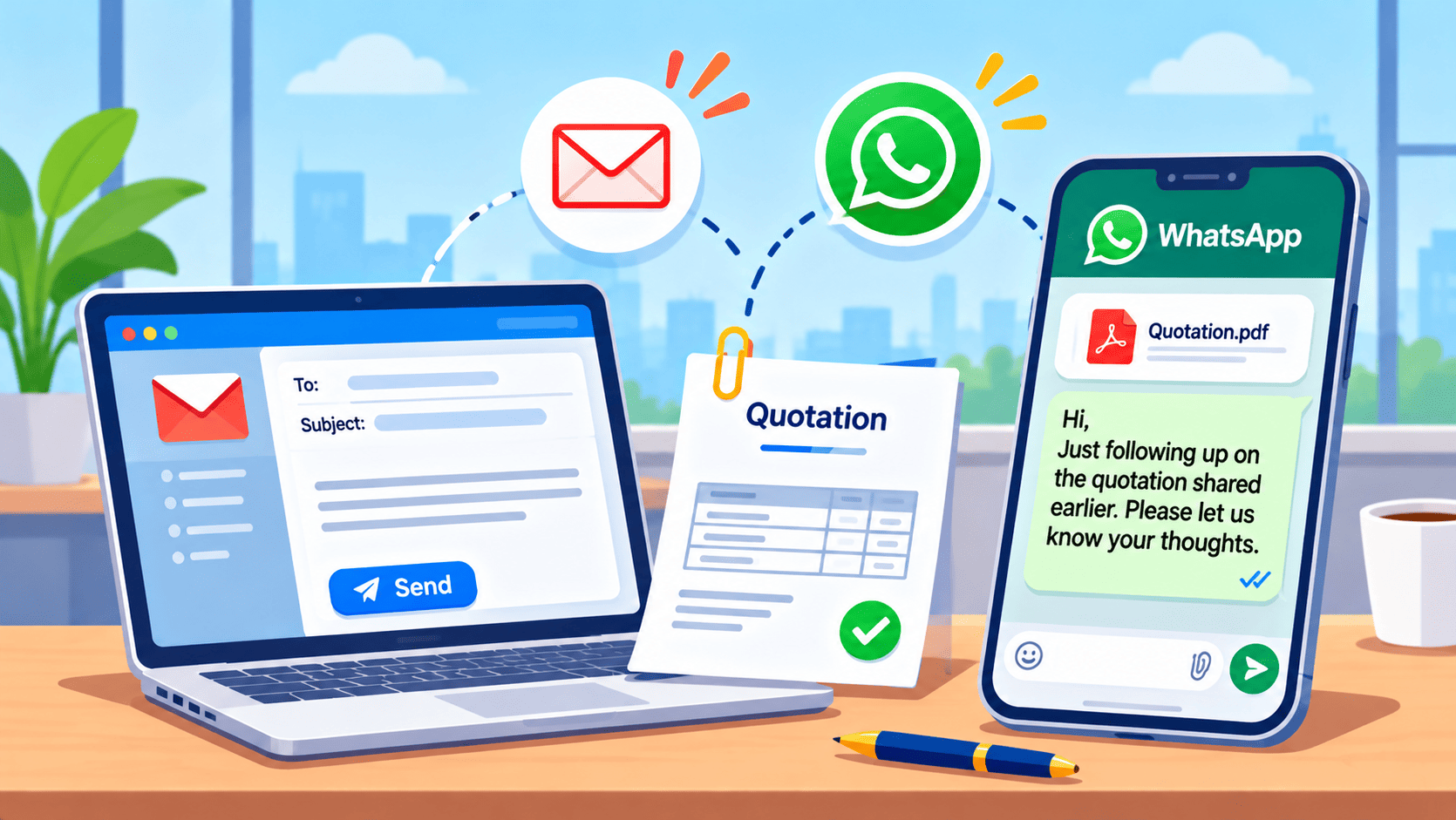
You spent an hour preparing the quote. You checked rates with the factory, added GST, attached the PDF and hit send. Then silence. For most Indian SMBs, the gap between "quote sent" and "order confirmed" is where deals go to die, not because the buyer said no, but because nobody asked again at the right time. A good quotation follow up email, paired with a short WhatsApp nudge, fixes much of that.
This post gives you ready-to-adapt samples for each stage after a quote, explains when to use email and when to use WhatsApp, and shows how to make the sequence run without anyone needing to remember it.
Table of contents
- Why quotes go silent
- The quotation follow up email cadence
- Email samples you can adapt
- WhatsApp samples for the same stages
- Mistakes that make buyers ghost you
- Hypothetical example: a packaging supplier in Surat
- How Wetroo helps
- FAQs
Why quotes go silent
Buyers rarely ignore a quote because they hate it. More often:
- They are comparing three or four suppliers and have not decided.
- The quote needs approval from a partner, purchase head or finance.
- Their project timeline moved.
- They had one doubt (delivery date, payment terms, freight) and never asked.
- Your email landed in a busy inbox and was simply forgotten.
Each of these has a different fix, which is why your follow-ups should not all say "Just checking in."
The quotation follow up email cadence
A simple cadence works for most B2B and high-ticket B2C sales in India:
| When | Channel | Goal |
|---|---|---|
| Same day | Confirm the quote was received, offer a quick call | |
| Day 2 or 3 | Clarify scope and invite questions | |
| Day 5 to 7 | WhatsApp + call | Address the likely objection (price, timeline, terms) |
| Day 10 to 14 | Add value: alternative option, case explanation, validity reminder | |
| Day 21 to 30 | Email or WhatsApp | Polite close-the-loop message |
Adjust the gaps to your sales cycle. A ?15,000 order may need a two-day cycle; a ?15 lakh machinery order may need weeks.
Email samples you can adapt
1. Day 2: The clarification email
Subject: Quotation #Q-2417 for corrugated boxes: any questions?
Dear Mr. Shah,
I hope you have had a chance to look at our quotation for 5,000 five-ply corrugated boxes sent on Tuesday. I have summarised the key points below so you do not need to open the PDF again:
- Rate: as per quote, inclusive of printing in two colours
- Delivery: within the timeline mentioned, from our Surat unit
- Payment terms: as discussed
If anything needs to be adjusted, such as size, quantity or delivery location, just reply here and I will revise it the same day.
Regards,
Neha Patel
2. Day 7: The objection-handling email
Subject: A lower-cost option for your box order
Dear Mr. Shah,
Many buyers comparing quotes ask whether the cost can come down without affecting strength. One option is a three-ply board for inner cartons while keeping five-ply for the outer shipper. I have attached a revised quotation showing both options side by side.
Happy to explain on a 10-minute call. What time works for you tomorrow?
3. Day 14: The validity reminder
Subject: Quotation #Q-2417 valid until 30th
Dear Mr. Shah,
A quick note that the rates in our quotation are valid until the 30th, as paper prices change frequently. If your requirement is still active, confirming before then will lock in the current rate. If the plan has changed, let me know and I will close the file on my side.
4. Day 30: The close-the-loop email
Subject: Should I close this quotation?
Dear Mr. Shah,
I have not heard back on the box order and do not want to keep filling your inbox. Should I close this enquiry for now, or is there a better time to reconnect? Either answer helps.
This "permission to close" message often gets a reply because it is easy to answer.
WhatsApp samples for the same stages
Indian buyers often reply faster on WhatsApp than email. Keep WhatsApp messages shorter and conversational. If you use the WhatsApp Business API, any message you send outside an open customer conversation must be an approved template, so keep these as clean templates with variables. Follow the WhatsApp Business Messaging Policy and only message buyers who have shared their number with you for this purpose.
Same day:
Hi {{name}}, this is {{rep}} from {{company}}. I have emailed the quotation for {{product}}. Let me know once you have seen it, happy to clarify anything on call.
Day 5:
Hi {{name}}, did the quotation for {{product}} work for you? If price or delivery is a concern, I can share an alternative option.
Day 14:
Hi {{name}}, a quick reminder that the rates for {{product}} are valid till {{date}}. Shall I hold them for you?
Day 30:
Hi {{name}}, should I close the quotation for {{product}} for now? Reply LATER if you would like me to check back next month.
Mistakes that make buyers ghost you
Generic "just following up" messages
They give the buyer nothing to respond to. Always include one specific question or one piece of new information.
Following up from personal numbers
When a rep leaves, the conversation leaves too. Use a business number connected to your CRM so the history stays with the company.
Discounting in the first follow-up
Leading with a discount teaches buyers to wait. Clarify value first; offer options before price cuts.
No owner, no reminder
The most common failure is simple: nobody was assigned to follow up, and nothing reminded them.
Quotation follow-up checklist
- Quote logged against the lead with amount and validity date
- Owner assigned
- Same-day WhatsApp confirmation sent
- Day 2/3 clarification email scheduled
- Likely objection noted after first call
- Validity reminder scheduled
- Close-the-loop message scheduled
- Outcome recorded: won, lost (with reason) or postponed
Hypothetical example: a packaging supplier in Surat
Illustrative scenario only; not a real customer.
A packaging company in Surat sends 60 to 80 quotations a month to D2C brands and exporters. Quotes went out from the owner's Gmail and follow-ups depended on his memory. After moving quotes into a CRM, each quotation creates a lead stage "Quote sent", which triggers a same-day WhatsApp template and reminders for the sales executive on day 3, 7 and 14. Every reply lands in one shared timeline. The owner now opens a filtered list each Monday showing quotes older than seven days with no response, and calls the biggest ones himself.
How Wetroo helps
Wetroo includes invoices and quotations, so a quote can sit right next to the lead and its conversation history. Sales sequences and drip campaigns can send the follow-up emails and approved WhatsApp templates on a schedule, while rule-based workflows move the lead when a stage changes. The mobile app gives your reps follow-up reminders, notes and the full client timeline, and Wetroo's email automation works with Gmail, Outlook and other webmail. Because WhatsApp runs on the official WhatsApp Business API, conversations stay with the business, not on one rep's phone.
FAQs
How long should I wait to follow up on a quotation?
Confirm receipt the same day, then follow up with substance within two to three days. After that, space messages further apart.
What should be the subject line of a quotation follow up email?
Reference the quote number and the product, and add a reason to open, for example "Quotation #Q-2417: a lower-cost option".
Is it OK to follow up on WhatsApp after emailing a quote?
Yes, if the buyer has shared their number and expects to hear from you. Keep it short and use approved templates if you are on the WhatsApp Business API.
How many times should I follow up on a quote?
Four or five touches over two to four weeks is reasonable for most B2B quotes, ending with a polite close-the-loop message.
Conclusion
A quotation is the start of a conversation, not the end of one. A structured quotation follow up email sequence, backed by short WhatsApp nudges and a clear owner for every quote, turns silence into decisions, whether that decision is yes, no or later. If you want quotes, reminders and follow-ups in one place, take a look at www.wetroo.com.



