


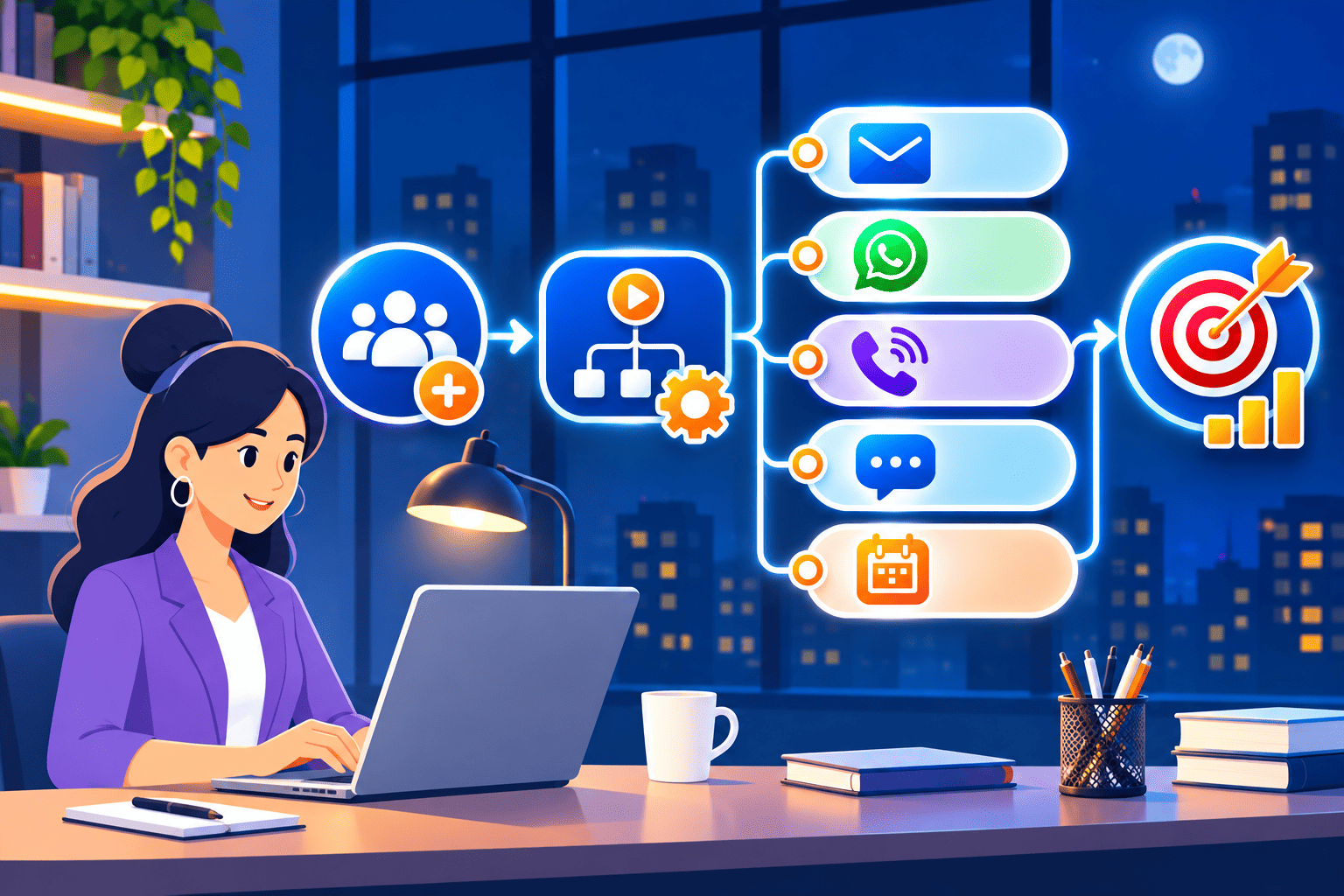
A good salesperson can personally follow up with 30 or 40 leads a day. Beyond that, something slips: a promised brochure is not sent, a callback is missed, a warm lead goes cold. Sales sequences solve the scale problem. A sequence is a pre-planned series of outreach steps (messages, emails, SMS and call tasks) that runs automatically for each lead from a trigger until an exit condition is met. Done well, sequences give every lead timely, consistent attention while salespeople focus on real conversations. This guide shows how to design, build, test and scale sales sequences for Indian businesses.
Table of contents
- What sales sequences are (and are not)
- Anatomy of a sequence
- Five sales sequences every SMB should build
- How to build sales sequences step by step
- Testing and optimising sequences
- A hypothetical example
- How Wetroo helps
- FAQs
- Conclusion
What sales sequences are (and are not)
A sequence is not a bulk broadcast. A broadcast sends the same message to many people at once. A sequence starts individually for each lead, at the moment they meet a trigger, and adapts based on what they do.
A sequence is also not a replacement for salespeople. The best sequences mix automated messages with call tasks assigned to humans. Automation does the reminding and the routine sending; people do the persuading.
| Broadcast | Sequence |
|---|---|
| Starts | All at once |
| Steps | One message |
| Personalisation | Low |
| Stops when | Never (one-off) |
| Best for | Announcements, offers |
Anatomy of a sequence
Every sequence has five parts:
- Trigger: what starts it, such as a new Facebook lead, an IndiaMART enquiry, a quotation sent or a demo completed.
- Audience filter: who qualifies, such as city, product interest, source or tag.
- Steps: each message or task, with channel, content and delay.
- Branching: what happens if the lead replies, clicks or books.
- Exit conditions: when the sequence stops for that lead.
Channels inside a sequence
- WhatsApp: high visibility. Messages sent outside the 24-hour customer service window must be approved templates, per Meta's pricing documentation. See our guide to WhatsApp template messages.
- SMS: good fallback. Commercial SMS in India requires registered headers and content templates under TRAI's TCCCPR framework.
- Email: ideal for quotations, proposals and detailed content.
- Call tasks: reminders for a salesperson to call at a specific step.
Five sales sequences every SMB should build
1. New lead sequence (Day 0–7)
- Minute 0: WhatsApp welcome + salesperson name
- Minute 1: call task for the owner
- Hour 4: SMS if WhatsApp undelivered and no call connected
- Day 1: WhatsApp brochure or catalogue
- Day 2: call task
- Day 4: WhatsApp testimonial or video
- Day 7: soft close
2. Quotation follow-up sequence
- Day 0: email with quotation PDF + WhatsApp notification
- Day 2: call task to discuss
- Day 4: WhatsApp offering a revision
- Day 7: email asking for feedback
3. No-show sequence (missed site visit, demo or appointment)
- Hour 1: WhatsApp "Sorry we missed you, want to reschedule?"
- Day 1: call task
- Day 3: WhatsApp with two new slots
4. Post-purchase onboarding sequence
- Day 0: thank-you message + what happens next
- Day 3: usage tips or installation guide
- Day 14: feedback request
- Day 30: referral ask
5. Re-engagement sequence (cold leads)
- Week 1: "What's new" message
- Week 3: a useful guide or offer
- Week 6: soft close or opt-out confirmation
How to build sales sequences step by step
Step 1: Pick one trigger and one goal
Start with the highest-volume trigger, usually new leads, and a single goal such as "book a site visit" or "schedule a demo".
Step 2: Map the steps on paper
Write each step: day, channel, message, owner. Keep the first version to five to eight steps.
Step 3: Write the messages
Keep them short and useful, in the customer's language. Prepare and submit WhatsApp templates for steps that fall outside the service window, and register SMS templates with your provider.
Step 4: Define exits and branches
- Lead replies → stop sequence, alert owner
- Lead books → switch to confirmation and reminder sequence
- Lead opts out → stop all marketing messages, record consent change
- Lead marked lost → stop and tag reason
Step 5: Assign call tasks to humans
Every sequence should have at least two human call steps. Automation should never be the only voice a hot lead hears.
Step 6: Launch for a subset
Run the sequence for one source or one team for two weeks before rolling out everywhere.
Sequence launch checklist
- Trigger and audience filter defined
- Steps mapped with delays and owners
- WhatsApp and SMS templates approved
- Exit rules tested with a dummy lead
- Opt-out handling in place
- Reporting set up by step
Testing and optimising sequences
Metrics to track
- Reply rate by step: which messages start conversations
- Goal completion rate: visits, demos or quotes booked
- Opt-out and block rate: a warning sign if rising
- Task completion: whether salespeople complete call steps on time
What to test
- Message wording and length
- Timing (morning vs evening, Day 1 vs Day 2)
- Channel order (WhatsApp first vs call first)
- Language (English vs Hindi or regional)
Change one variable at a time and compare results over a few weeks.
Common mistakes
- Too many steps too close together
- No exit when the lead replies, so the customer gets automated messages mid-conversation
- Generic messages with no personalisation
- Forgetting to update sequences when offers or prices change
For a broader view of workflows beyond sequences, see our guide to sales automation workflows, and for timing principles, designing a follow-up cadence.
A hypothetical example
Illustrative scenario, not a real business.
A modular furniture brand in Pune receives leads from Instagram ads and its website. Salespeople were inconsistent: some leads got four calls in a day, others none.
The team builds a new lead sequence: instant WhatsApp welcome with a catalogue, a call task in the first minute, a design-consultation invite on Day 1, a short customer video on Day 3 and a soft close on Day 7. Replies stop the sequence and alert the owner. They also build a quotation follow-up sequence. After a month, they see that the Day 1 consultation invite drives the most bookings, so they move it earlier and test a Hindi version for leads from smaller cities.
How Wetroo helps
Wetroo includes sales sequences and drip campaigns as core features, alongside rule-based, no-code workflows. You can trigger sequences from new leads captured from Facebook Ads, Instagram, Google Ads lead forms, IndiaMART or WordPress forms, and send steps over WhatsApp (via the official Business API), SMS and email, with follow-up reminders for calls.
Teams and sub-teams with custom assignment rules make sure every lead in a sequence has a clear owner, and the analytics dashboard helps you see how sources and teams perform. If you want help designing workflows, Wetroo's pricing page lists an automation workflow setup assistance service at ?5,000 + GST at the time of writing.
FAQs
What are sales sequences?
Automated, multi-step outreach plans that run for each lead from a trigger until they reply, book, buy or opt out.
How many steps should a sales sequence have?
Start with five to eight steps over one to two weeks, and refine based on results.
Can sales sequences include WhatsApp?
Yes, using the official WhatsApp Business API and approved templates for messages outside the 24-hour service window.
What is the difference between a sequence and a drip campaign?
The terms overlap. A drip campaign usually refers to spaced, mostly automated messages for nurturing, while a sales sequence typically mixes messages with human call tasks and stops as soon as the lead engages.
Do sequences replace salespeople?
No. Good sequences combine automated messages with call tasks for salespeople.
Conclusion
Sales sequences let a small team give every lead fast, consistent, multi-channel attention. Define the trigger, map the steps, write useful messages, set clear exits, include human calls, and optimise by step. Start with one sequence, prove it works, then scale. To build sequences across WhatsApp, SMS, email and calls in one CRM, explore www.wetroo.com.



