


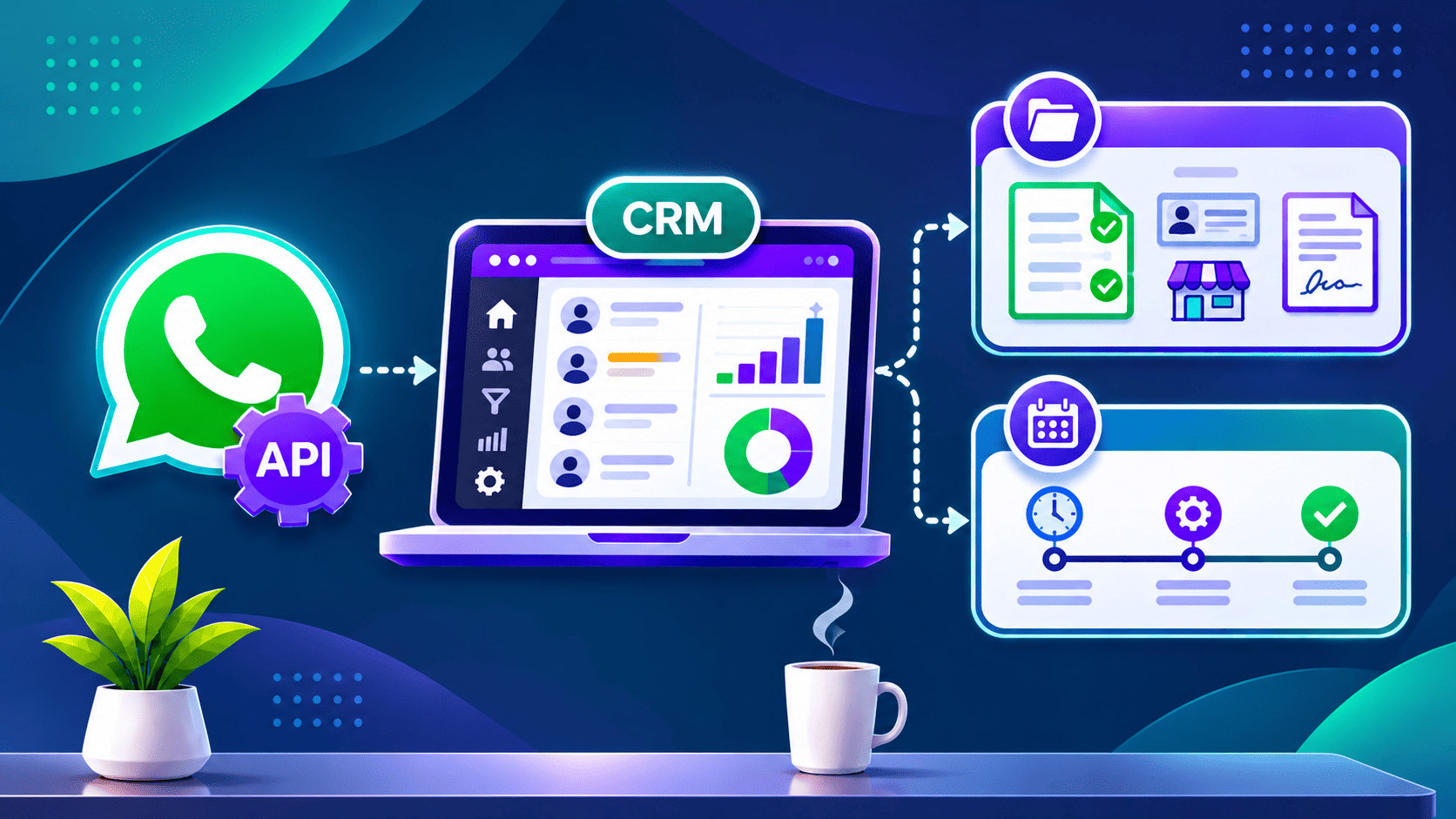
Connecting WhatsApp to your CRM is one of the highest-impact upgrades a sales team can make: instant replies to new leads, a shared team inbox, automated follow-ups and every chat logged on the customer record. But many businesses get stuck at the start, not because the technology is hard but because they are missing an admin login, a suitable phone number or a document Meta asks for. This guide to WhatsApp API setup for CRM lists what to prepare before you begin, walks through the typical steps and explains what speeds up or slows down the timeline.
Table of contents
- Before you start: the prerequisites
- The setup steps for WhatsApp API setup for CRM
- Timelines: what affects how long it takes
- Costs to plan for
- Common setup mistakes to avoid
- After setup: first-week tasks
- Hypothetical example
- How Wetroo helps
- FAQs
- Conclusion
Before you start: the prerequisites
Most delays come from missing prerequisites. Gather these first.
1. Admin access to your Meta Business Manager
You need admin access to the Meta business portfolio (Business Manager) that will own your WhatsApp account. Wetroo's pricing page, for example, lists this as a requirement before getting started. If an agency or former employee created your Business Manager, get admin access transferred before setup day.
2. A suitable phone number
Choose the number customers will see. It must be able to receive a verification code (SMS or voice call). If the number is currently active on the regular WhatsApp or WhatsApp Business app, plan how it will be moved or choose a different number, since the platform and the app handle numbers differently.
3. Your business display name
The display name should reflect your business and is reviewed by Meta. Avoid generic words alone or names that do not match your brand.
4. Business details and documents
Keep your legal business name, address, website and official business documents handy. Business verification in Meta Business Manager asks for documents that confirm your legal name and address; Meta's Business Help Centre lists accepted documents for your country (facebook.com/business/help).
5. Policy compliance
Your business and use case must follow WhatsApp's business and commerce policies. Some categories of products are restricted.
6. A payment method
Meta charges per delivered template message, by category and market (WhatsApp Business Platform pricing). You will need a payment method on the messaging account, through Meta or your provider.
Pre-setup checklist
- Admin access to Meta Business Manager confirmed
- Phone number chosen and able to receive OTP
- Display name decided
- Website live with business details
- Business documents ready for verification
- Use case checked against WhatsApp policies
- Payment method ready (cards enabled for online/international transactions if required)
The setup steps for WhatsApp API setup for CRM
The exact screens vary by provider, but the flow usually looks like this.
Step 1: Start from your CRM or provider
In your CRM's WhatsApp settings, launch the connection. Many providers use Meta's Embedded Signup flow, which, according to Meta's documentation, gathers information about your business and creates a WhatsApp account and a messaging account for you (Meta for Developers).
Step 2: Log in with Facebook and select your business portfolio
Use the account with admin rights. Select the correct business portfolio, or create one if needed.
Step 3: Create or select your WhatsApp account
Enter business details and the display name.
Step 4: Add and verify the phone number
Enter the number and verify it with the OTP.
Step 5: Grant the CRM access
Approve the permissions so your CRM can send and receive messages.
Step 6: Add a payment method
Set up billing for message charges.
Step 7: Create your first templates
Submit templates for your most important messages: new lead intro, appointment reminder, quote follow-up. Templates need approval before use for business-initiated messages.
Step 8: Connect automations
In the CRM, link templates to triggers: new lead → intro; stage change → update; no reply → follow-up.
Step 9: Test end to end
Submit a test lead, check the message arrives, reply, and confirm the conversation appears on the CRM record and in the shared inbox.
Timelines: what affects how long it takes
Setup time varies widely by business, so avoid relying on a fixed number of days. These factors matter most:
| Factor | Speeds things up | Slows things down |
|---|---|---|
| Business Manager access | You are already admin | Access held by an agency or ex-employee |
| Phone number | New or ready number | Number still active on the app; migration needed |
| Display name | Matches brand and website | Generic or mismatched name |
| Business verification | Documents ready and consistent | Name/address mismatch across documents and website |
| Templates | Clear, specific purpose | Vague or promotional text in wrong category |
| Payment | Card enabled for online/international use | Card declined or limits too low |
Meta's documentation also notes that business verification affects limits: for example, an unverified portfolio's messaging account can hold up to 250 templates, rising to 6,000 once verified with an approved display name. You can usually start with basic messaging while verification is in progress, then expand.
Costs to plan for
- Meta message charges for template messages and, beyond the free tier, service messages, per delivered message by category and market. From 1 October 2026, service replies within the 24-hour customer service window are free for the first 1,000 per business number each month and charged after that, per Meta's developer documentation; Meta also says it will stop delivering service messages beyond the free tier if no payment method is on file.
- Provider or CRM fees: subscription and any setup charges. At the time of writing, Wetroo's pricing page lists optional WhatsApp API setup at ?1,000 plus 18% GST per setup for monthly plans; check wetroo.com/pricing.
- Internal time for template writing and testing.
Common setup mistakes to avoid
- Using a salesperson's personal number. When they leave, the business loses the conversation history and the number.
- Letting an agency own the Business Manager. Agencies can be given partner access; ownership and admin rights should stay with your company.
- Writing templates on the day of launch. Approval can take time; prepare them in advance.
- Skipping the end-to-end test. A missing permission or webhook often shows up only when a real lead arrives.
After setup: first-week tasks
- Train the team on the shared inbox: assigning chats, internal notes, quick replies.
- Approve a small template library: intro, reminder, follow-up, win-back.
- Turn on one automation (new lead intro) and watch replies closely.
- Set opt-in practices: capture consent on forms and honour opt-outs.
- Monitor quality: watch for blocks or reports and adjust messages.
- Consider green-tick eligibility later; it is a separate application with its own criteria.
Hypothetical example
This is a hypothetical example for illustration, not a real customer.
A tile showroom in Morbi wants WhatsApp connected to its CRM before the wedding season. The first attempt stalls because the Business Manager was created by a former digital agency. The owner gets admin access transferred, chooses a new dedicated number instead of migrating the personal WhatsApp Business app number, keeps GST and address details consistent between the website and documents, and prepares three templates in advance. With prerequisites in place, the remaining steps proceed smoothly, and the team starts with automated intros for IndiaMART and Facebook leads.
How Wetroo helps
Wetroo is powered by the official WhatsApp Business API, and its verified offering includes:
- WhatsApp Business API connection, with green-tick application support on eligible plans.
- Optional setup assistance and automation workflow setup assistance listed on the pricing page.
- An implementation manager, data migration and team training on every plan.
- Omnichannel inbox, sales sequences, drip campaigns and rule-based workflows once connected.
- Lead capture from Facebook, Instagram, Google Ads forms, IndiaMART and WordPress to trigger WhatsApp automations.
FAQs
What do I need to set up WhatsApp API for my CRM?
Admin access to Meta Business Manager, a phone number that can receive an OTP, a display name, business details and documents for verification, policy compliance and a payment method.
How long does WhatsApp API setup take?
It varies. With access, number, documents and templates ready, it can be quick; missing admin access, number migration or verification issues cause most delays.
Can I use my existing WhatsApp number for the API?
Often yes, through a migration process, but it affects how you use the app on that number. Discuss options with your provider.
Do I need business verification to start?
You can often begin with limited capabilities, but verification unlocks higher limits and is recommended.
Who in my company should own the WhatsApp API setup?
Ideally one person with admin access to Meta Business Manager who also understands your sales process, often the owner or sales operations lead. They coordinate with the provider, approve templates and make sure the team is trained on the shared inbox before automations go live.
Conclusion
Successful WhatsApp API setup for CRM is mostly preparation: admin access, the right number, a clear display name, consistent documents and a few well-written templates. Get those in place, follow the steps with your provider and test end to end before switching on automations.
To connect WhatsApp to your sales CRM with implementation support, explore Wetroo at www.wetroo.com.



