


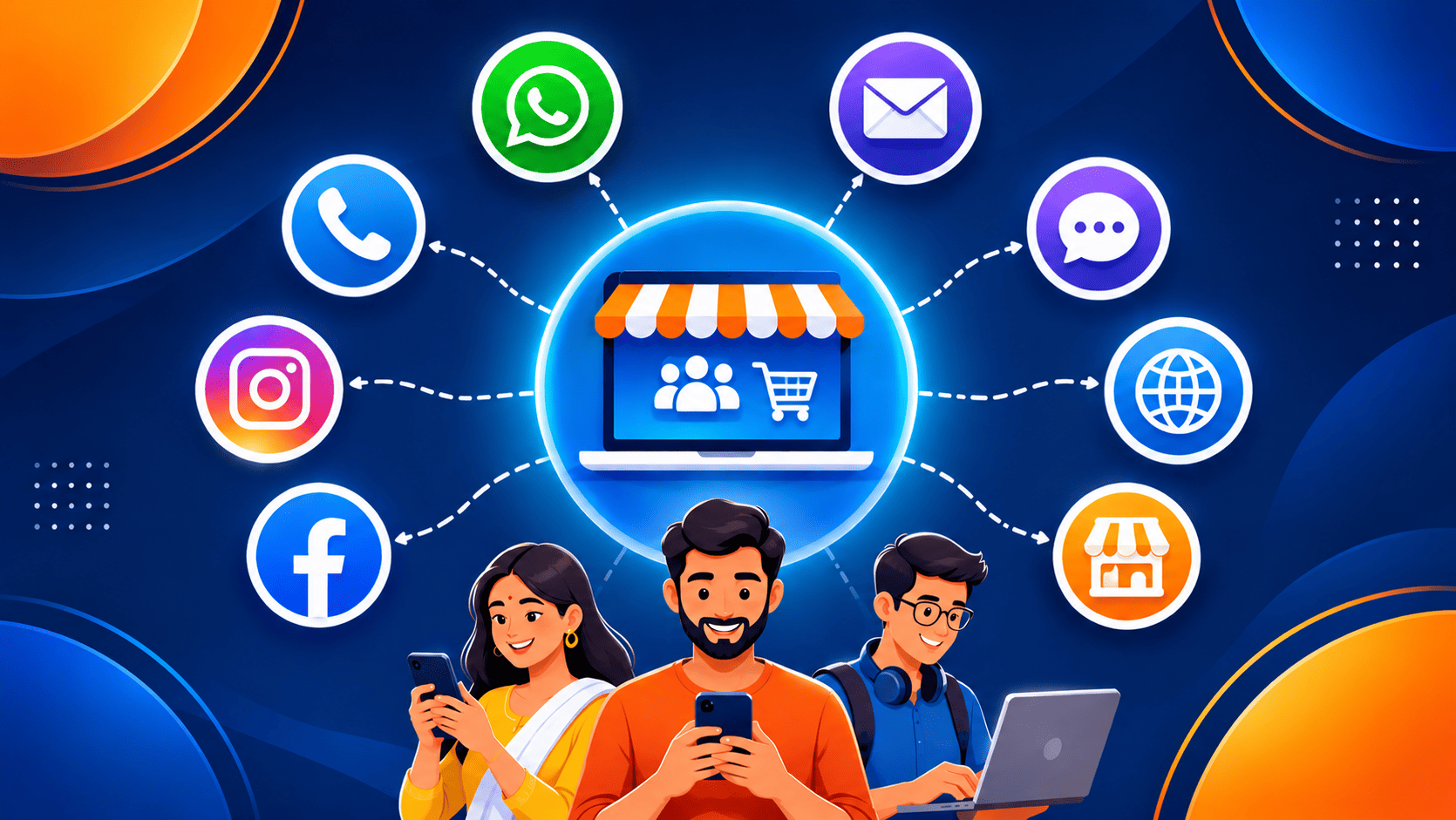
A buyer sees your Instagram reel on Monday, sends a DM asking for the price, fills a Facebook lead form on Wednesday, calls your number on Friday and finally says "send me the payment link on WhatsApp". To the buyer, this is one conversation with one business. To many Indian SMBs, it is four separate leads handled by three people, none of whom knows what the others said. If you have ever asked what is omnichannel sales, this is the problem it solves.
This guide gives you a plain-language definition, explains how it differs from multichannel selling, maps the channels Indian buyers actually use and shows how to make them work as one.
Table of contents
- What is omnichannel sales? A simple definition
- Multichannel vs omnichannel: the key difference
- The channels Indian buyers use
- Why WhatsApp sits at the centre in India
- What an omnichannel sales process looks like
- Common omnichannel sales mistakes
- Hypothetical example: a furniture retailer in Ahmedabad
- How Wetroo helps
- FAQs
What is omnichannel sales? A simple definition
Omnichannel sales means selling across every channel your buyers use while keeping a single, continuous view of each buyer. Whatever channel they use next, your team knows who they are, what they asked, what was promised and what should happen next.
Three ideas sit inside that definition:
- Presence: you are reachable where buyers already are.
- Continuity: the conversation carries over between channels without the buyer repeating themselves.
- Ownership: one person or team is responsible for the buyer, regardless of channel.
Omnichannel is not about being on every platform. It is about joining the platforms you use into one experience.
Multichannel vs omnichannel: the key difference
Many businesses are already multichannel. They have Instagram, a website, a phone number and WhatsApp. But each channel works in isolation.
| Multichannel | Omnichannel |
|---|---|
| Channels | Several |
| Customer record | Separate per channel |
| Conversation history | Scattered across apps and phones |
| Who replies | Whoever handles that app |
| Buyer experience | Repeats details on each channel |
| Reporting | Per channel, hard to combine |
The difference is not the number of channels. It is whether the data and the conversation are connected.
The channels Indian buyers use
Every business is different, but these are the channels most Indian SMBs see in their sales conversations:
Messaging
- WhatsApp: questions, catalogues, quotes, payment links, delivery updates, follow-ups.
- Instagram DMs: discovery-led questions, especially for D2C, fashion, food, beauty and education.
- Facebook Messenger: still used by many buyers responding to Facebook ads.
- Telegram: used in some niches such as education, trading and communities.
Voice
- Inbound calls and missed calls: especially for higher-ticket or urgent purchases.
- Outbound telecalling: still the backbone of real estate, finance, education and insurance sales.
- IVR: routes calls to the right team and captures callers after hours.
Forms and marketplaces
- Facebook and Instagram lead ads, Google Ads lead forms and website forms.
- IndiaMART and similar B2B marketplaces for manufacturers, traders and service providers.
Email and SMS
- Email for formal quotes, proposals and B2B communication.
- SMS for short reminders and reaching people who are not on data or do not respond on WhatsApp.
Why WhatsApp sits at the centre in India
In many countries, omnichannel strategies are built around email or live chat. In India, WhatsApp is usually the place where conversations end up, no matter where they started. A Facebook lead often prefers a WhatsApp message to a call. An IndiaMART buyer asks for a catalogue on WhatsApp. A caller says, "Send me the details on WhatsApp."
That makes a practical rule for Indian SMBs: design your omnichannel sales process with WhatsApp as the hub. Every channel should be able to hand a buyer into a WhatsApp conversation that your team, not one rep's personal phone, owns. For business use at scale, that means the official WhatsApp Business Platform connected to your CRM, so messages, templates and history are attached to the customer record.
What an omnichannel sales process looks like
1. Capture every enquiry into one place
Forms, ads, marketplaces, calls and DMs should all create or update a single lead record automatically.
2. Identify the buyer across channels
Phone number is the most common identifier in India. When the same number calls, messages and fills a form, it should map to one lead, not three.
3. Assign one owner
Assignment rules decide who owns the buyer, by source, product, language or region.
4. Reply on the buyer's preferred channel
If they enquired on Instagram but asked for WhatsApp, move there and note it. Do not force your preferred channel on them.
5. Keep one timeline
Calls, notes, chats and emails should appear in one history so anyone picking up the lead knows the context.
6. Automate the gaps
Instant acknowledgements, follow-up sequences and after-hours bots keep the conversation alive when humans are busy.
Omnichannel readiness checklist
- All lead sources flow into one system automatically
- WhatsApp runs on a business account owned by the company
- Each lead has one owner and one timeline
- Team replies to WhatsApp, Instagram and Facebook from one shared inbox
- Follow-ups are reminded or automated
- Reports show which channels lead to sales, not just enquiries
Common omnichannel sales mistakes
Opening channels you cannot staff
Adding Telegram or Messenger looks good on a website, but every channel you open is a promise to reply. Start with the channels your buyers already use and add more only when you can respond within your normal service standard.
Letting reps sell from personal numbers
It feels fast at first. But when a salesperson leaves or changes phones, the chat history, the buyer's trust and sometimes the buyer leave too. Keep business conversations on business-owned numbers connected to your CRM.
Measuring channels in isolation
An Instagram DM may not close a sale, yet it may be the reason a buyer later called. Look at the full journey before deciding a channel "does not work".
Hypothetical example: a furniture retailer in Ahmedabad
This is an illustrative scenario, not a real business.
A furniture store in Ahmedabad sells through its showroom, Instagram and Facebook ads. Instagram DMs were answered by the owner's nephew, WhatsApp by two salespeople on their own phones, and calls by the front desk. Buyers often had to explain their requirement three times.
The store connects its lead forms, Instagram, Facebook and a business WhatsApp number to one CRM with a shared inbox. Each buyer gets one owner. When a buyer who DM'd about a sofa later calls the showroom, the front desk sees the earlier chat and the photos shared, and invites them to see the exact model. Follow-ups after showroom visits go out on WhatsApp automatically. The owner can now see which channel brought each sale.
How Wetroo helps
Wetroo is designed for WhatsApp-first omnichannel selling. Its omnichannel inbox brings Facebook, Instagram, Telegram and WhatsApp conversations together, and it supports the official WhatsApp Business API, SMS, email, IVR and SIM-based calling. Leads from Facebook Ads, Instagram, Google Ads lead forms, IndiaMART and WordPress forms are captured automatically, with 100+ integrations and webhooks for other sources.
Custom assignment rules give every buyer an owner, the client timeline keeps history in one place, and sales sequences, drip campaigns and AI agents that chat, call, qualify and follow up 24/7 fill the gaps between human conversations. Chatbots can be built in English, Hindi, Marathi, Tamil, Telugu, Bengali, Gujarati and Kannada.
FAQs
What is omnichannel sales in simple words?
Selling through all the channels your buyers use while keeping one connected record and conversation for each buyer.
What is the difference between omnichannel and multichannel?
Multichannel means using many channels separately. Omnichannel connects them so data and conversations flow between channels.
Is WhatsApp enough for omnichannel sales?
WhatsApp is often the hub in India, but buyers also come from ads, marketplaces, calls and Instagram. Omnichannel means connecting all of them.
Do small businesses need omnichannel sales?
Yes, once enquiries come from more than one or two channels or more than one person replies. That is when context starts getting lost.
Conclusion
So, what is omnichannel sales for an Indian SMB? It is meeting buyers on WhatsApp, Instagram, calls, forms and marketplaces while running one conversation, one owner and one record behind the scenes. Start by capturing everything in one place and making WhatsApp a business-owned hub. To see how an omnichannel inbox and automation can work for your team, visit www.wetroo.com.



