


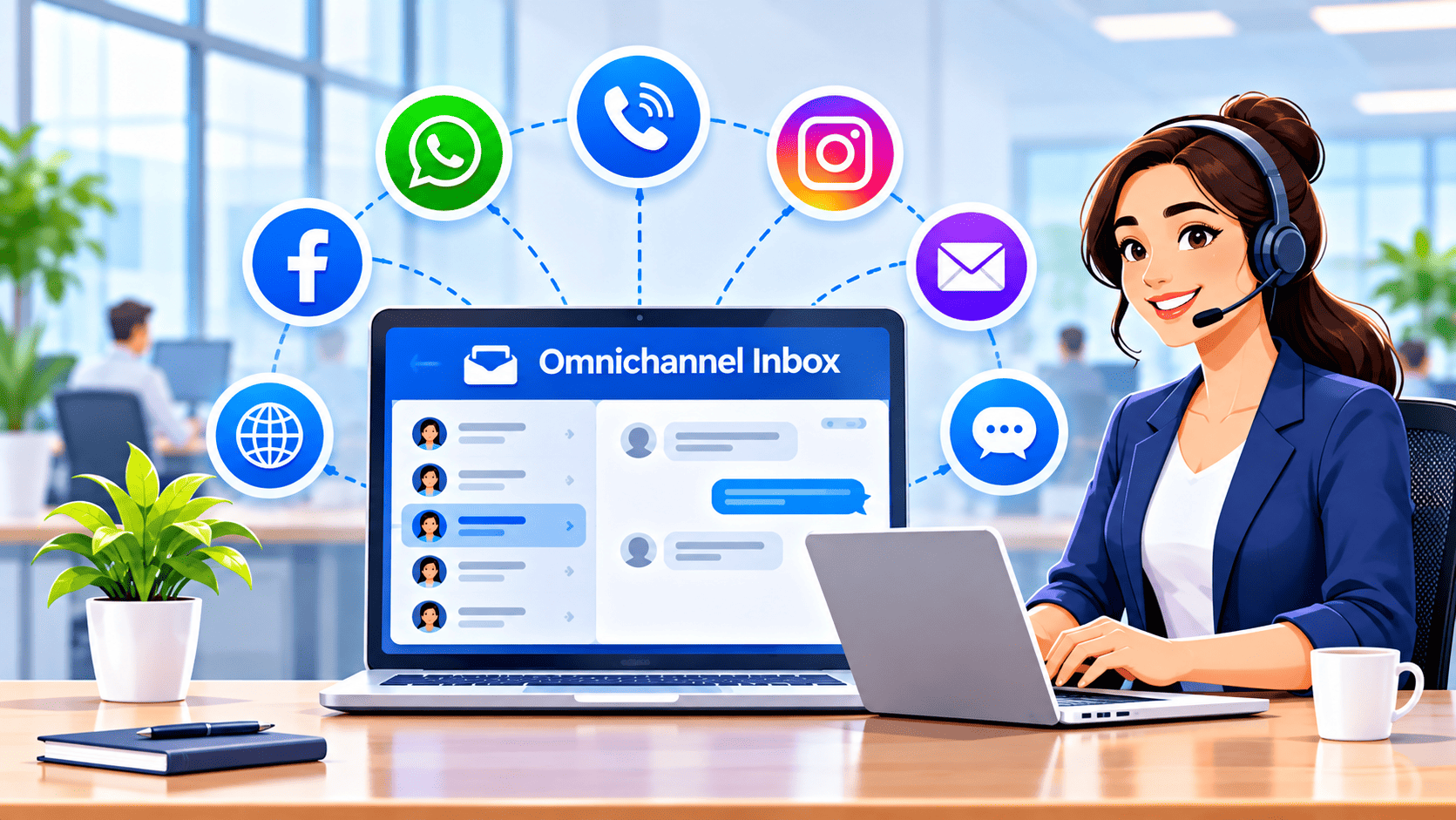
Customers do not think in channels. A buyer might see your Instagram reel, send a DM asking the price, switch to WhatsApp to share a photo, and later reply to a Facebook ad. Your team, however, often sees those as three separate conversations on three separate apps, sometimes on three different phones. What is an omnichannel inbox? It is a single workspace where messages from all those channels, such as WhatsApp, Instagram, Facebook Messenger and Telegram, arrive in one place, are linked to the same customer and can be handled by the whole team with full context.
The idea came from customer service, but it is just as powerful for sales. This post gives a sales-focused definition, explains how omnichannel differs from multichannel and shared inboxes, and outlines the features and benefits that matter for Indian teams.
Table of contents
- What is an omnichannel inbox? A sales definition
- Multichannel vs omnichannel vs shared inbox
- Core features to expect
- Benefits for sales teams
- Why it matters especially in India
- Setting up an omnichannel inbox for sales
- Common mistakes
- Hypothetical example
- How Wetroo helps
- FAQs
- Conclusion
What is an omnichannel inbox? A sales definition
An omnichannel inbox is a unified messaging workspace that:
- Collects conversations from multiple messaging channels into one view.
- Links each conversation to a single customer or lead record, so history follows the person, not the channel.
- Lets multiple team members collaborate: assign, transfer, add notes, reply.
- Connects to your CRM and automation, so conversations can trigger workflows and update the pipeline.
In sales terms, it is the place where enquiries become conversations and conversations become pipeline.
Multichannel vs omnichannel vs shared inbox
| Concept | What it means | Limitation |
|---|---|---|
| Multichannel | You are present on many channels | Each channel is handled separately |
| Shared inbox | Several people work from one channel's inbox (for example, one WhatsApp number) | May cover only one channel |
| Omnichannel inbox | Many channels, one inbox, one customer view, shared by the team | Needs integration with each channel and a CRM |
A business can be multichannel without being omnichannel. The omnichannel difference is continuity: the customer's story is connected across channels.
Core features to expect
Channel connections
WhatsApp (through the official WhatsApp Business API), Instagram DMs, Facebook Messenger, Telegram, and sometimes website chat, SMS and email.
Unified customer view
All messages, calls, notes and deals for a contact in one timeline.
Assignment and collaboration
Assign conversations to individuals or teams, transfer them, mention colleagues and add internal notes the customer cannot see.
Quick replies and templates
Saved responses for common questions; approved WhatsApp templates for business-initiated messages.
Automation and bots
Auto-replies, chatbots and AI agents that respond instantly and hand over to humans.
Status and SLAs
Open, pending, resolved; alerts for unanswered conversations.
Reporting
Response times, volumes by channel, conversations by owner and outcomes.
Benefits for sales teams
1. No lost conversations
Every DM and message lands in one place with an owner.
2. Faster responses
One screen means less app-switching; alerts flag waiting customers.
3. Context in every reply
Salespeople see what the customer said on Instagram before replying on WhatsApp.
4. Business continuity
When a salesperson is on leave or leaves the company, conversations stay with the business, not a personal phone.
5. Better management visibility
Managers see unanswered chats, response times and who is handling what.
6. Cleaner data
Conversations update lead records, so pipeline reports reflect reality.
7. Easier coaching
Managers can read real conversations, spot replies that win customers and share them with the team, instead of relying on second-hand summaries of what was said.
8. Consistent brand voice
Saved replies and templates mean every customer receives accurate prices, policies and timings, whoever is answering and whichever channel they used.
Why it matters especially in India
- WhatsApp is the default business channel for many customers, often alongside Instagram for discovery.
- Click-to-WhatsApp and Instagram ads generate conversations rather than form fills.
- Teams often share phones or numbers, which an omnichannel inbox replaces with proper multi-user access.
- Regional languages are common; bots and agents can respond in the customer's language before a human steps in.
For WhatsApp in particular, an omnichannel inbox should sit on the official WhatsApp Business API. Meta's documentation describes the account structure businesses use on the platform (Meta for Developers), and its pricing documentation explains per-message charges and the free monthly tier of service messages per business number that applies from 1 October 2026 (Meta pricing documentation).
Setting up an omnichannel inbox for sales
- List your channels by volume and importance.
- Connect them to one platform, starting with WhatsApp and Instagram for most Indian SMBs.
- Define ownership rules: by product, city, language or round robin.
- Write quick replies for the ten most common questions.
- Add a bot or AI agent for instant first responses and after-hours coverage.
- Set response-time targets and alerts.
- Train the team on assignment, notes and handover etiquette.
Handover etiquette for teams
Shared inboxes work best with a few simple team rules:
- Claim before you reply. Assign the conversation to yourself so two people do not answer at once.
- Leave a note when you hand over. One line, such as "Customer wants red lehenga, budget ?80k, wedding 12 Feb", saves the next person from re-asking.
- Introduce the handover. A short message like "I'm Priya, I'll help you with fittings from here" keeps the experience personal.
- Close the loop. Mark conversations resolved or set a follow-up reminder, so nothing sits half-finished.
Omnichannel inbox checklist
- Priority channels connected
- Conversations linked to CRM contacts
- Assignment rules live
- Quick replies and approved templates ready
- Bot/AI first response with human handover
- Response-time alerts
- Weekly reporting review
Common mistakes
- Connecting channels but not the CRM, so conversations never become pipeline.
- No ownership rules, which recreates the "who replies?" problem in a nicer interface.
- Over-automation, where bots never let customers reach a person.
- Ignoring internal notes, so context stays in people's heads.
Hypothetical example
This is a hypothetical example for illustration, not a real customer.
A bridal boutique in Ludhiana gets most enquiries through Instagram DMs and WhatsApp, with occasional Facebook messages. Three stylists used their own phones, so customers who switched channels had to repeat measurements and preferences. The boutique moves to an omnichannel inbox: all channels flow into one workspace, each customer's conversations are linked, a bot greets new enquiries and asks the wedding date and budget, and conversations are assigned to stylists by availability. When a stylist is away, a colleague picks up the thread with full history.
How Wetroo helps
Wetroo's verified features include:
- Omnichannel inbox that unifies Facebook, Instagram, Telegram and WhatsApp in one shared inbox.
- Official WhatsApp Business API, with broadcasting and retargeting.
- Chatbot builder in eight languages and AI agents with live human transfer.
- Teams and assignment rules, lead timelines and notes.
- Sales sequences and workflows so conversations flow into your pipeline.
FAQs
What is an omnichannel inbox in simple terms?
One shared inbox where your team sees and replies to customer messages from WhatsApp, Instagram, Facebook and other channels, with each customer's history in one place.
What is the difference between a shared inbox and an omnichannel inbox?
A shared inbox lets many people work from one inbox, often for one channel. An omnichannel inbox combines many channels and links conversations to one customer view.
Is an omnichannel inbox only for customer support?
No. Sales teams use it to respond faster, qualify leads and keep conversation history connected to the pipeline.
Do I need the WhatsApp Business API for an omnichannel inbox?
For multi-user WhatsApp access and automation at scale, yes, the official API is the recommended route.
Can a small team of two or three use an omnichannel inbox?
Yes. Small teams often benefit the most, because one person can no longer watch every app. A single inbox with assignment and alerts lets a tiny team respond like a much larger one.
Conclusion
What is an omnichannel inbox? It is the single place where every customer conversation, across WhatsApp, Instagram, Facebook and more, is captured, owned and connected to your CRM. For sales teams, it means fewer lost chats, faster replies and full context in every conversation.
To bring your channels into one inbox, explore Wetroo at www.wetroo.com.



