


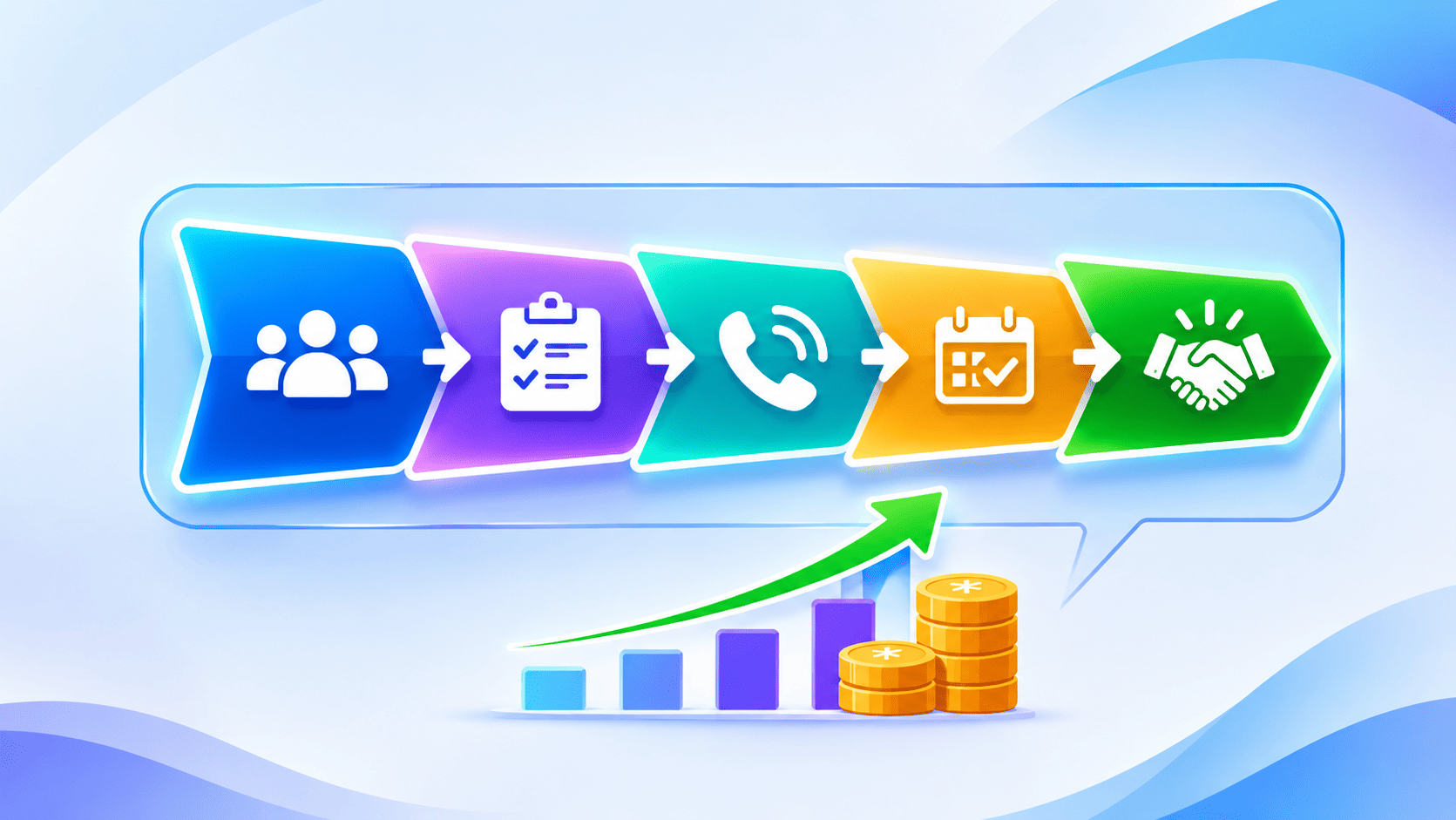
Imagine writing every live deal on a sticky note and arranging the notes in columns on a wall: "New enquiry", "Spoke to them", "Sent quote", "Negotiating", "Won". Glance at the wall and you instantly know how much business is in progress, where it is stuck and what needs attention today. That wall is the simplest answer to what is a sales pipeline. A CRM just turns the wall into something your whole team can update from their phones.
This beginner's guide explains the idea visually, shows how pipelines differ by industry in India, and walks you through building your first one.
Table of contents
- What is a sales pipeline? The plain definition
- A visual pipeline, column by column
- Pipeline vs funnel: are they the same?
- Sales pipeline examples from Indian businesses
- How to build your first pipeline
- Pipeline health signs every beginner should watch
- Hypothetical example: a CCTV installer in Lucknow
- How Wetroo helps
- FAQs
What is a sales pipeline? The plain definition
A sales pipeline is a visual, stage-by-stage view of every active opportunity your business is working on, from first contact to closed deal. Each opportunity sits in exactly one stage at a time, and moves forward (or drops out) as the buyer takes steps toward purchase.
A pipeline answers three questions:
- How many deals are in progress?
- Where is each deal right now?
- What is the next action to move it forward?
It is a working tool, not a report. Salespeople use it every day to decide what to do next.
A visual pipeline, column by column
Here is a simple pipeline that fits many Indian SMBs:
| New | Contacted | Qualified | Proposal / Visit | Negotiation | Won | Lost |
|---|---|---|---|---|---|---|
| Fresh enquiry, not yet reached | Spoke or chatted at least once | Budget, need and timeline confirmed | Quote sent, demo done or site visit held | Discussing price, terms, approval | Payment or order received | Not proceeding, with reason |
Picture each column holding cards. Each card shows the buyer name, value, owner and next follow-up date. When a card has no next step, it is at risk.
What makes a stage useful
A good stage is defined by a buyer action, not a salesperson's feeling. "Qualified" should mean you have confirmed specific facts, not that the rep "has a good feeling". Clear definitions keep the pipeline honest.
Pipeline vs funnel: are they the same?
People use the terms interchangeably, but they look at the same process from different angles.
- The pipeline is about deals and actions: what is each deal doing and what should we do next? It is used by salespeople daily.
- The funnel is about volumes and conversion: out of 1,000 leads, how many became qualified and how many bought? It is used by managers and marketers to measure.
You need both. The pipeline is how you work; the funnel is how you learn.
Sales pipeline examples from Indian businesses
Pipelines should mirror how your buyers actually buy. A few examples:
Real estate developer
New enquiry → Contacted → Site visit scheduled → Site visit done → Negotiation → Booking amount received → Agreement
The site visit is the critical stage, which is why it gets two columns.
B2B manufacturer selling through IndiaMART
New enquiry → Requirement understood → Sample/catalogue sent → Quotation sent → Negotiation → PO received
Many B2B sellers get enquiries through marketplaces like IndiaMART, where a quick and specific reply moves the buyer to "requirement understood".
Education or coaching institute
New enquiry → Counselling call done → Demo class/webinar attended → Fee discussed → Admission confirmed
Service business (interiors, solar, CCTV)
New enquiry → Site inspection booked → Inspection done → Quote sent → Advance received → Installation
How to build your first pipeline
Step 1: List the real steps
Look at your last ten sales. What happened between enquiry and payment? Write those steps down. Remove anything that is not a clear milestone.
Step 2: Keep it to five to eight stages
Fewer stages means faster updates. You can always add detail later.
Step 3: Define entry rules
For each stage, write one sentence: "A deal enters this stage when..." Share it with the team.
Step 4: Require a next step
Every deal outside Won/Lost should have a dated next action. This single rule improves most pipelines immediately.
Step 5: Record lost reasons
Price, competitor, not reachable, requirement changed. Lost reasons are free market research.
Step 6: Review weekly
Look for deals stuck in a stage for too long, deals with no next step and stages where many deals drop.
First-pipeline checklist
- Five to eight stages based on real sales
- Entry rule written for each stage
- Every open deal has an owner and next follow-up
- Lost reasons are mandatory
- Weekly 20-minute pipeline review on the calendar
Pipeline health signs every beginner should watch
Once your pipeline is running, a few simple signals tell you whether it is healthy.
Deals without a next step
If a deal has no follow-up date, nobody will touch it. This is the single most common reason small businesses lose deals they could have won.
Stuck deals
Every stage has a normal waiting time. A quote that usually gets an answer in a week but has been sitting for a month needs a call or a polite close-the-loop message.
A crowded top, an empty middle
Lots of new enquiries but very few qualified deals usually means slow first response or weak lead sources. Check how quickly new leads are contacted before blaming marketing.
Lost deals with no reasons
If most lost deals say "other" or nothing at all, you are missing the clearest feedback your market can give you. Keep the reason list short and make it mandatory.
Unrealistic values
If every deal is entered at the highest possible value, the pipeline total stops meaning anything. Encourage honest estimates and update them after each conversation.
Hypothetical example: a CCTV installer in Lucknow
Illustrative scenario only, not a real business.
A CCTV installation company in Lucknow gets enquiries from Google Ads, IndiaMART and referrals. The owner kept deals in his head and a diary. Some quotes were never followed up, and he could not tell how much business was in progress.
He sets up a six-stage pipeline: New, Contacted, Site survey done, Quote sent, Advance received, Installed. Each deal must have a next follow-up date. In the first weekly review, he notices many deals are sitting in "Quote sent" for more than ten days with no next step. He adds a rule: every quote gets a follow-up call on day three and a WhatsApp reminder on day seven. The pipeline does not create more leads, but it stops the ones he already has from quietly disappearing.
How Wetroo helps
Wetroo gives you a place to run your pipeline with your whole team. Leads from Facebook Ads, Instagram, Google Ads lead forms, IndiaMART and WordPress forms enter automatically, are assigned by custom rules, and can be tagged, searched and filtered by stage.
The Android and iOS apps let reps update notes, follow-up reminders and the client timeline on the go. Sales sequences, drip campaigns and rule-based workflows can move a lead or send a message when it reaches a stage, and the analytics dashboard shows managers where deals are and where they stall. Quotations and invoices can be created alongside the lead.
FAQs
What is a sales pipeline in simple terms?
A stage-by-stage view of all the deals you are working on, showing where each one is and what needs to happen next.
How many stages should a sales pipeline have?
Most SMBs do well with five to eight stages based on real buyer milestones.
What is the difference between a lead and a deal in a pipeline?
A lead is an enquiry; a deal or opportunity is a lead you have qualified as a real potential sale. Some small teams track both in one pipeline.
How often should I review my pipeline?
Salespeople should check it daily; managers should review it as a team weekly.
Conclusion
What is a sales pipeline? It is the wall of sticky notes every business needs, made shareable and always up to date. Define stages around buyer actions, give every deal a next step and review it weekly, and you will see exactly where revenue is coming from and where it is leaking. To build and run your pipeline with automatic lead capture and reminders, visit www.wetroo.com.



