


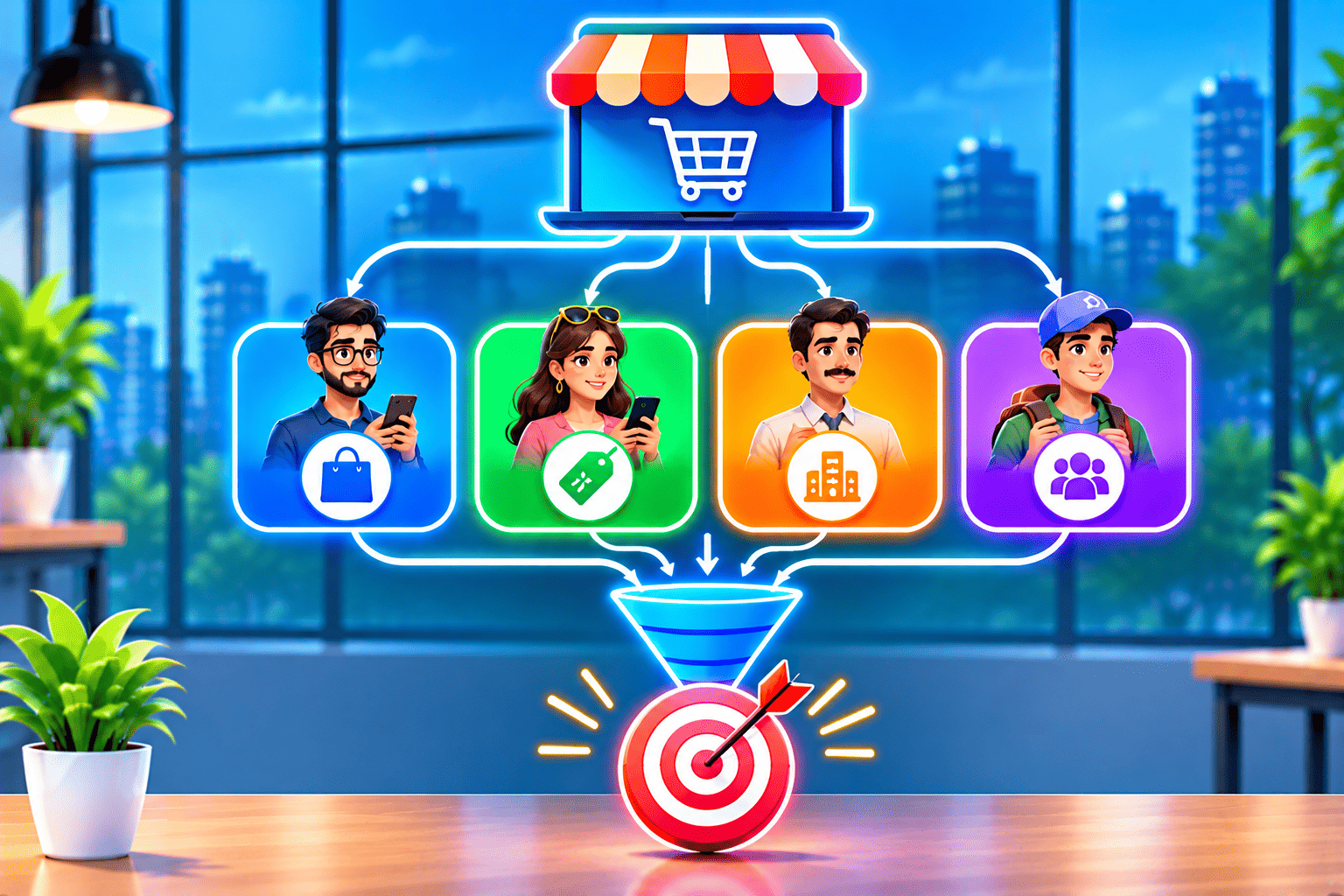
Trying to sell to everyone is the quickest way to sell to no one. Your ads get expensive, your messages feel generic and your team wastes time on leads that were never a good fit. Learning to segment marketplace buyers, breaking a broad market into smaller groups with shared needs, fixes that. It isn't a big-company exercise either. For small businesses with tight budgets, market segmentation is often the difference between marketing that pays for itself and marketing that disappears. This guide covers the main types of segmentation, a six-step method, a worked template and how to put segments to work inside a CRM.
Table of contents
- What does it mean to segment a marketplace?
- The main types of market segmentation
- How to segment marketplace buyers in six steps
- Segmenting buyers who come through online marketplaces
- Turning segments into messages
- A segment profile template
- Common segmentation mistakes
- A hypothetical example
- How Wetroo helps
- FAQs
- Conclusion
What does it mean to segment a marketplace?
Market segmentation means dividing your potential customers into groups that are similar in ways that affect how they buy. Each group, or segment, can then receive a message, offer and sales approach that suits it. The concept is well established in marketing; the Wikipedia overview of market segmentation is a useful primer on its history and variations.
A good segment has four qualities:
- Distinct: its needs differ from other segments.
- Reachable: you can find and contact these people through a channel you use.
- Large enough: it is worth the effort for your business.
- Actionable: you can actually change your message, offer or process for it.
Segmentation is not just for advertising. It shapes which leads your best rep handles, which product you lead with on a call and what you send past customers in the festive season.
The main types of market segmentation
Demographic
Age, gender, income, occupation, family stage or education. Useful for consumer products and services, for example a coaching institute segmenting parents of Class 10 students versus working professionals.
Geographic
Country, state, city, locality or urban versus rural. In India, geography often brings differences in language, festivals, pricing expectations and delivery logistics.
Psychographic
Values, lifestyle, interests and attitudes. A premium home décor brand might segment by "design-conscious" versus "value-focused" buyers.
Behavioural
How people interact with you: products viewed, frequency of purchase, response to offers, loyalty, or the channel they enquired through. Behavioural segments are often the most useful for small businesses because the data is already in your CRM.
Firmographic (for B2B)
Industry, company size, location, number of employees or annual purchase volume. A packaging supplier on IndiaMART might segment buyers into small retailers, mid-sized manufacturers and large distributors.
How to segment marketplace buyers in six steps
- Start with your existing customers. Look at who already buys from you. What do your best customers have in common: city, industry, product, order size, how they found you?
- Choose two or three variables that change buying behaviour. Don't use every type at once. For example, "city" and "product interest" may be enough.
- Define each segment in one sentence. "Small retailers in Tier-2 cities buying under ?50,000 per order" is clearer than "small buyers."
- Check size and value. Count how many leads and customers fall into each segment, and which ones bring the most revenue or repeat orders.
- Tailor message, offer and channel. Decide what each segment hears, what you offer and whether WhatsApp, calls or email works best.
- Measure and refine. After a few weeks, compare response and conversion by segment. Merge segments that behave the same; split ones that don't.
The order matters. Starting from real customers keeps segments grounded in evidence rather than assumptions about who "should" buy.
Segmenting buyers who come through online marketplaces
Many Indian small businesses get a large share of enquiries from B2B and B2C marketplaces such as IndiaMART. These leads need their own thinking, because the buyer has often contacted several sellers at once and the enquiry form carries limited detail.
A few practical approaches help:
- Segment by the product or category enquired about. The marketplace usually tells you what the buyer searched for or clicked on, which is a strong signal of need.
- Segment by stated quantity or order size. Retail-sized and bulk enquiries deserve different responses and often different reps.
- Segment by location. Delivery cost, lead time and language preferences vary by state and city.
- Segment by response behaviour. Buyers who reply quickly to your first message are a different group from those who go silent, and they deserve a faster, more personal follow-up.
Because marketplace buyers compare sellers, speed and relevance matter more than usual. Tagging each enquiry by segment the moment it arrives means the first reply can already be tailored instead of generic.
Turning segments into messages
A segment is only useful when it changes what you say. For each segment, write one short first message and one follow-up. For example, a price-sensitive retailer segment might receive a bulk-slab price list, while a quality-focused manufacturer segment receives specifications and certifications first. Keep the tone respectful and the content specific to the segment's main need.
A segment profile template
Fill in one row per segment. Keep it to three to five segments to begin with.
| Field | Segment A | Segment B | Segment C |
|---|---|---|---|
| One-line definition | |||
| Main need or problem | |||
| Where they come from (lead source) | |||
| Preferred channel | |||
| Lead offer or message | |||
| Rep or team who owns it | |||
| CRM tag | |||
| How you'll measure success |
The last two rows are what turn segmentation from a planning exercise into daily practice.
Common segmentation mistakes
- Too many segments. Ten segments for a three-person team means none gets real attention.
- Segments you can't act on. If you can't change the message or offer, the segment is just a label.
- Ignoring behaviour. Demographics are easy to collect, but how people actually buy often matters more.
- Never revisiting. Markets shift. Review segments every few months.
- Keeping segments in a slide deck. If segments aren't tagged in your CRM, your team won't use them.
- Segmenting without consent awareness. Targeting is only appropriate for people who have agreed to hear from you; keep messages relevant and easy to opt out of.
A hypothetical example
This is a hypothetical scenario for illustration only. The business and figures are invented.
A Ludhiana manufacturer of industrial fasteners receives enquiries from IndiaMART, its website and trade referrals. Everyone gets the same price list and the same follow-up. Reviewing past orders, the owner defines three segments: small hardware retailers (frequent small orders, price-sensitive, prefer WhatsApp), OEM manufacturers (large repeat orders, need technical specifications, prefer email and calls) and project contractors (one-off bulk orders, urgent timelines). Each enquiry is now tagged by segment during the first call. Retailers receive a WhatsApp catalogue with bulk slabs, OEM leads go to the senior salesperson with a spec sheet, and contractors get a same-day quotation. A few months later, the owner compares conversion by segment and adjusts how much time each segment receives.
How Wetroo helps
Segmentation becomes useful when it's built into everyday tools. Wetroo supports this in several ways:
- Tag and filter: lead tagging, search and filters to group leads and customers by segment.
- Route by segment: teams and sub-teams with custom assignment rules, so each segment reaches the right rep.
- Tailor messages: sales sequences, drip campaigns, broadcasting and retargeting across WhatsApp (via the WhatsApp Business API), SMS and email.
- Speak the buyer's language: a chatbot builder in English, Hindi, Marathi, Tamil, Telugu, Bengali, Gujarati and Kannada.
- Measure: an analytics dashboard and Meta Conversions API sync, which can feed outcomes back to your Facebook and Instagram campaigns so they learn which leads convert.
- Capture source automatically: lead capture from Facebook Ads, Instagram, Google Ads lead forms, IndiaMART and WordPress forms.
FAQs
What are the four main types of market segmentation?
Demographic, geographic, psychographic and behavioural. B2B businesses often add firmographic segmentation.
How many segments should a small business have?
Usually three to five to start. Fewer, well-defined segments are easier to act on than many vague ones.
Which segmentation type is best for small businesses?
Behavioural segmentation is often the most practical because it uses data you already have, such as purchase history and lead source.
How does a CRM help with segmentation?
A CRM lets you tag leads and customers by segment, route them to the right person, send tailored messages and compare results by segment.
Conclusion
To segment marketplace buyers well, start with the customers you already have, pick a few variables that genuinely change how people buy, and build each segment into your CRM with tags, owners and tailored messages. Review the results regularly and refine. For small businesses, that focus often makes marketing spend go further. If you'd like to put segments to work inside your sales process, start free at www.wetroo.com, no credit card required.



