


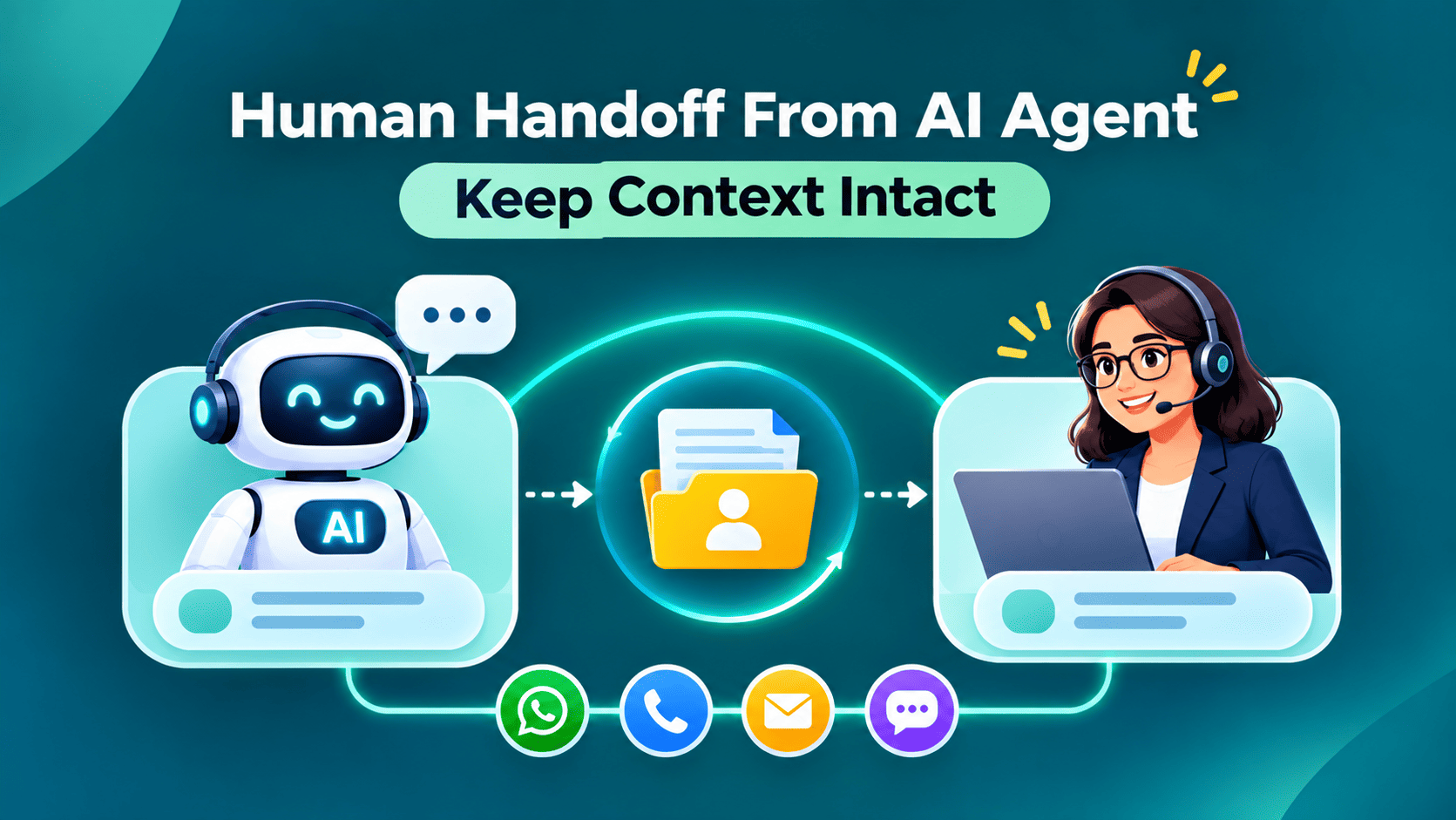
AI agents can now answer WhatsApp enquiries at midnight, call new leads within moments and ask qualifying questions in Hindi or Tamil. That is a big step for Indian SMBs that cannot staff sales round the clock. But the moment that decides whether the buyer has a good experience is not the AI conversation. It is the transfer. A clumsy human handoff from AI agent to salesperson, where the buyer has to repeat everything and the rep has no idea what was said, undoes all the speed you gained.
This guide covers when to hand off, what context must travel with the lead, and how to keep chat and call history continuous in one inbox.
Table of contents
- Why the handoff is the moment of truth
- When a human handoff from AI agent should happen
- What context must travel with the handoff
- Handoff on chat vs on calls
- Designing the human side of the handoff
- Mistakes that break context
- Hypothetical example: a car dealership in Ludhiana
- How Wetroo helps
- FAQs
Why the handoff is the moment of truth
An AI agent's job in sales is usually to respond instantly, qualify and route. The human's job is to build trust, handle nuance and close. The handoff is where the two meet.
When it goes well, the buyer feels the business is organised: "They already know what I want." When it goes badly, the buyer feels processed: "I just told the bot all this."
It also matters for policy. WhatsApp's Business Messaging Policy says businesses may use automation when responding within the 24-hour window, but must also provide prompt, clear and direct escalation paths, such as in-chat transfer to a human agent, a phone number or email. A handoff design is not optional on WhatsApp; it is part of responsible automation.
When a human handoff from AI agent should happen
Define triggers in advance. Common ones:
Buyer-driven triggers
- The buyer asks for a human ("Can I talk to someone?")
- The buyer expresses frustration or confusion
- The buyer asks something outside the agent's scope (custom pricing, legal, complaints)
Qualification-driven triggers
- The lead meets your "hot" criteria, such as budget in range, timeline within a month, decision-maker on the line
- The buyer asks to book a visit, demo or meeting
- The buyer requests a quote for a specific quantity
Risk-driven triggers
- Sensitive topics: payments, refunds, medical or financial advice
- Repeated misunderstanding by the AI
- High-value accounts that you always want a human to handle
Handoff trigger matrix
| Situation | Hand off? | How |
|---|---|---|
| Asks for a human | Always | Immediate during hours; scheduled callback after hours |
| Meets hot criteria during working hours | Yes | Live transfer (call) or assign in inbox (chat) |
| Meets hot criteria at night | Yes, scheduled | Priority task for morning with summary |
| Simple FAQ (location, timings) | No | AI answers |
| Complaint or payment issue | Yes | Route to support or manager |
| AI misunderstands twice | Yes | Assign to human with transcript |
What context must travel with the handoff
The rep should never start from zero. Every handoff should carry:
- Who: name, phone, preferred language, source (which ad, form or marketplace)
- What they want: product, configuration, quantity, budget range, timeline
- What was already said: full transcript or call summary, plus key answers in structured fields
- What was promised: "Our expert will call you in 10 minutes", "We will share the price sheet"
- Why it was handed off: the trigger
- What to do next: suggested next step, such as call now, book visit, send quote
Structured fields beat transcripts alone
A transcript is useful, but a rep with 30 leads will not read every word. Map key answers into CRM fields (budget, city, timeline) and add a three-line summary at the top.
Handoff on chat vs on calls
Chat (WhatsApp, Instagram, Facebook)
On chat, the conversation should stay in the same thread. The AI agent pauses, the conversation is assigned to a human in the shared inbox, and the human replies in the same chat. The buyer sees one continuous conversation with one business number.
Good practice: the AI tells the buyer what is happening. "I'm connecting you with Rohit from our sales team. He can see our conversation, so you won't need to repeat anything."
Calls (AI calling)
On calls, a live transfer connects the buyer to a human while they are still on the line. The human should see the AI's qualification answers on screen before saying hello. If no human is available, the AI should set a callback time and create a priority task.
Good practice: the human's first line shows they have context. "Hi Mr. Singh, I understand you are looking at the automatic variant and want a test drive this weekend. Let's fix a time."
Designing the human side of the handoff
The AI side gets attention; the human side often does not. Make sure:
- Someone is available. Define who receives handoffs at each hour, with a backup.
- Alerts are instant. Push notifications on mobile, not just a dashboard badge.
- Response standards exist. For example, chat handoffs picked up within a few minutes during working hours.
- Ownership is clear. The lead is assigned to the human who takes over, so follow-ups are theirs.
- Feedback loops exist. Reps can flag bad handoffs so you can improve triggers and scripts.
Handoff readiness checklist
- Handoff triggers written and configured
- Context fields and summary defined
- Same-thread continuity on chat
- Live transfer set up for calls during hours
- After-hours callback flow defined
- On-duty roster and backup for handoffs
- Instant mobile alerts for handoffs
- Weekly review of a sample of handoffs
Mistakes that break context
- Moving the buyer to a different number ("Please WhatsApp our sales team on this other number"). The thread breaks and so does trust.
- No summary. Reps skim nothing and ask everything again.
- Silent handoffs. The AI stops replying and nobody tells the buyer someone is coming.
- Handoffs to nobody. Leads routed to a rep on leave sit untouched.
- The AI pretending to be human. Be transparent that the first responder is an automated assistant.
Hypothetical example: a car dealership in Ludhiana
This is an illustrative scenario, not a real dealership.
A dealership in Ludhiana runs Facebook and Instagram lead ads for a new SUV. Leads arrive day and night. An AI agent calls each new lead within moments to confirm interest, preferred variant, budget range, exchange vehicle and test-drive preference, in Punjabi, Hindi or English.
During showroom hours, when a lead asks for a test drive, the AI live-transfers the call to the on-duty sales consultant, whose screen shows the variant, budget and exchange details. At night, the AI books a callback and the lead is assigned with a summary for the 10 am shift. On WhatsApp, the same lead's chat continues in the dealership's shared inbox, so the consultant can send the brochure and test-drive confirmation in the same thread. The sales manager reviews five handoffs each week to refine triggers.
How Wetroo helps
Wetroo's AI agents chat, call, qualify and follow up 24/7, and Wetroo's AI calling supports live transfer to a human. Conversations from WhatsApp (official API), Facebook, Instagram and Telegram sit in one omnichannel inbox, so a human can take over in the same thread.
Custom assignment rules decide who receives each handoff, instant alerts reach reps on the Android and iOS apps, and the client timeline, notes and lead tags keep context in one place. Rule-based workflows and follow-up reminders make sure after-hours handoffs become morning callbacks rather than forgotten leads.
FAQs
What is a human handoff from an AI agent?
The transfer of a conversation from an AI chat or voice agent to a human, ideally with full context so the buyer does not repeat themselves.
When should an AI chatbot transfer to a human?
When the buyer asks, when the lead is hot, when the topic is sensitive or outside scope, or when the AI misunderstands repeatedly.
Does WhatsApp require a human option for chatbots?
WhatsApp's Business Messaging Policy says automated responses must be accompanied by prompt, clear and direct escalation paths, such as transfer to a human agent.
How do I keep context during AI to human transfer?
Keep the conversation in one thread or inbox, pass a short summary and key fields, and alert the assigned human instantly.
Conclusion
A great human handoff from AI agent to salesperson is invisible to the buyer: one thread, one business, no repetition. Define clear triggers, pass structured context, keep chat and call history in one inbox and make sure a human is ready to catch the transfer. To combine 24/7 AI agents with smooth human takeover, explore www.wetroo.com.



