


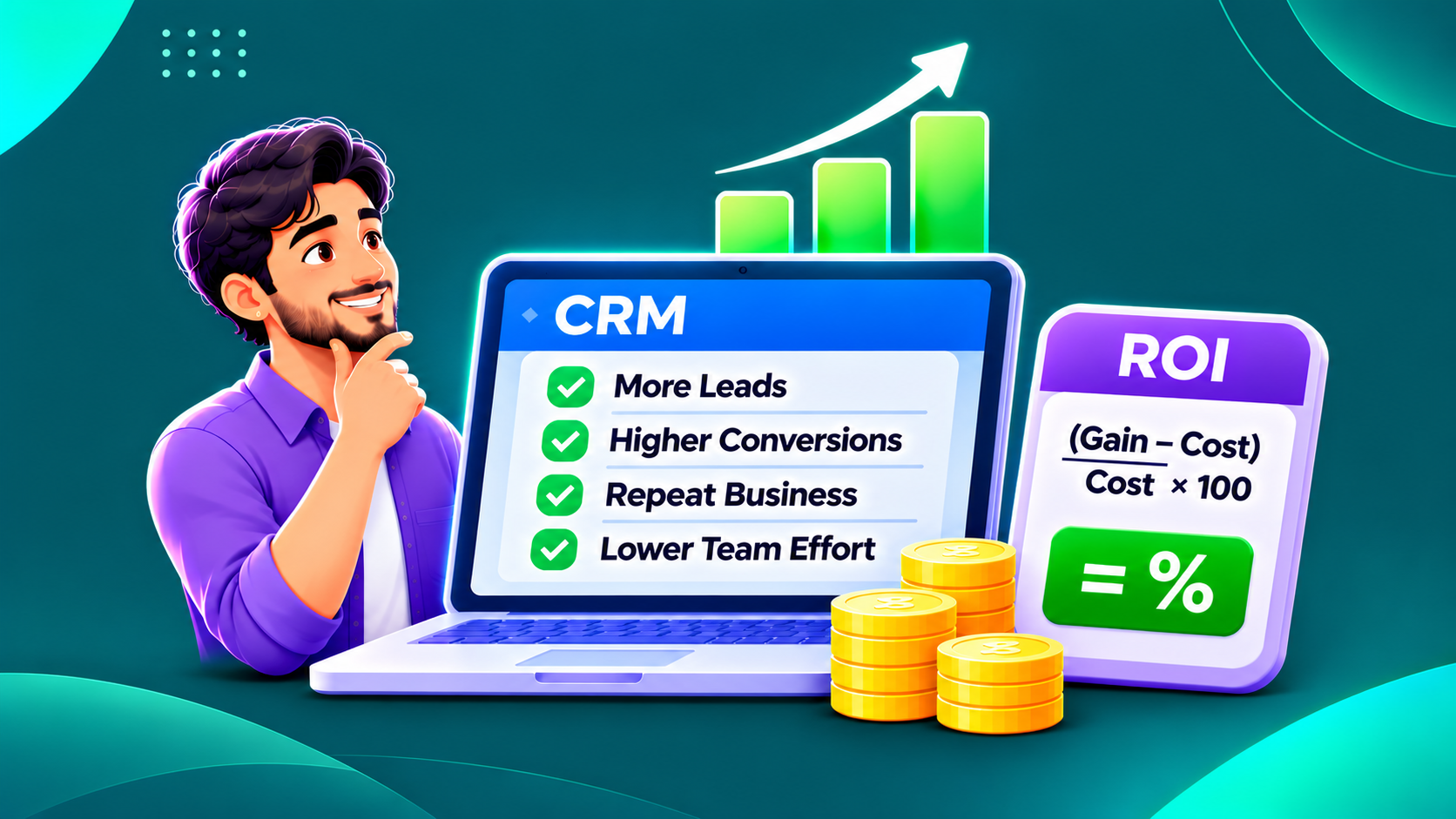
Every small business owner asks the same question before buying software: "Will this pay for itself?" For a CRM, the honest answer is "it depends on how many leads you are currently losing and how much time your team wastes". The good news is that you can estimate both with numbers you already have. This guide gives you a simple, transparent way to calculate CRM ROI for small business, using two levers you can actually measure: hours saved on follow-up work and revenue recovered from leads that currently leak.
No inflated industry averages, no magic multipliers. Just your own numbers.
Table of contents
- What CRM ROI actually means
- The two levers: time saved and leads recovered
- CRM ROI for small business: the formula
- A worked example in INR
- Costs to include honestly
- How to measure ROI after you buy
- Hypothetical example: a travel agency's first quarter
- How Wetroo helps
- FAQs
What CRM ROI actually means
Return on investment compares what you gain with what you spend:
ROI (%) = (Gain − Cost) ÷ Cost × 100
For a CRM, the "gain" usually comes from two places:
- Productivity: your team spends less time on manual work, such as copying leads, searching chats, remembering follow-ups and building reports.
- Revenue: more leads are contacted, followed up and converted because nothing slips through.
There are softer benefits too, such as better customer experience, less dependence on individual reps and cleaner data for decisions. They are real but harder to price, so leave them out of the core calculation and treat them as a bonus.
The two levers: time saved and leads recovered
Lever 1: Hours saved on follow-ups and admin
List the manual tasks your team does today:
- Downloading leads from Facebook, IndiaMART or Google and pasting them into a sheet
- Forwarding leads to reps on WhatsApp
- Typing the same intro message again and again
- Searching through chats for a customer's last conversation
- Updating status columns at the end of the day
- Building a weekly report by hand
Estimate minutes per day per person for each, then convert to hours per month. Multiply by the cost of an hour of that person's time (monthly salary ÷ working hours).
Lever 2: Revenue from recovered leads
Leads leak when they are never contacted, contacted too late, or not followed up after the first attempt. To estimate:
- Take last month's leads.
- Count how many were never contacted or had no follow-up after the first call. Check your sheet, CRM trial or call logs.
- Assume a conservative share of those could have converted if handled properly. Use a rate lower than your current conversion rate to stay realistic.
- Multiply by your average gross profit per sale (not revenue, to be conservative).
CRM ROI for small business: the formula
Putting it together:
Monthly gain = (Hours saved × hourly cost) + (Recovered sales × gross profit per sale)
Monthly ROI (%) = (Monthly gain − Monthly CRM cost) ÷ Monthly CRM cost × 100
A worked example in INR
All numbers below are hypothetical, chosen only to show the method.
A business with four salespeople receives 600 leads a month.
| Input | Value |
|---|---|
| Time saved per rep per day | 45 minutes |
| Working days per month | 25 |
| Hours saved per month (4 reps) | 75 hours |
| Cost per rep hour (?25,000 salary ÷ 200 hours) | ?125 |
| Value of time saved | ?9,375 |
| Leads never contacted or not followed up | 90 |
| Conservative conversion on recovered leads | 2% → about 2 sales |
| Gross profit per sale | ?8,000 |
| Value of recovered sales | ?16,000 |
| Total monthly gain | ?25,375 |
| CRM cost per month (example) | ?4,000 |
| Monthly ROI | (25,375 − 4,000) ÷ 4,000 × 100 ≈ 534% |
Change any input to match your business. If your result is negative even with honest assumptions, you may not need a CRM yet, or you may need a simpler one.
Sensitivity check
Run the calculation three times: pessimistic, realistic and optimistic. If ROI is positive even in the pessimistic case, the decision is easy.
Common ROI calculation mistakes
- Using revenue instead of profit. A recovered ?50,000 sale with a ?10,000 margin adds ?10,000 of gain, not ?50,000.
- Assuming every saved hour becomes a sale. Time saved is valuable only if it is spent on selling. Track what reps do with the extra time.
- Ignoring adoption. A CRM that half the team uses produces half the gain. Factor in a ramp-up period for the first month.
- Counting the same benefit twice. If faster response recovers a lead, count it once, under recovered sales, not again under productivity.
Costs to include honestly
A fair calculation counts all costs, not just the subscription:
- Subscription fees per month or year, plus GST
- Setup or onboarding fees, if any
- WhatsApp Business API message charges, billed per message by category at the time of writing
- Add-ons, such as calling or IVR
- Team time for training in the first few weeks
- Data migration effort
For reference, at the time of writing Wetroo's plans start at ?1,999 per organisation per month plus GST; check wetroo.com/pricing for current plans and add-ons.
How to measure ROI after you buy
Estimates are a starting point. After three months, measure actual results:
- Untouched leads: how many leads were never contacted? This should fall sharply.
- First response time: how quickly does the first call or message go out?
- Follow-ups completed vs due: is discipline improving?
- Conversion rate by source: is it higher than before?
- Time on admin: ask reps to estimate again.
ROI tracking checklist
- Baseline numbers recorded before go-live
- Lead source captured on every lead
- Stages and lost reasons defined
- Monthly review of untouched leads and response time
- Quarter-end comparison against baseline
Hypothetical example: a travel agency's first quarter
Illustrative scenario only; not a real agency.
A travel agency in Kolhapur with three agents gets enquiries from Instagram ads, its website and IndiaMART. Before the CRM, the owner estimated agents spent close to an hour a day copying leads and searching chats, and many weekend enquiries were never called.
He records a baseline: monthly leads, leads contacted, bookings and average margin per booking. After connecting lead sources, auto-assignment and WhatsApp follow-up sequences, he checks again at the end of the quarter. Fewer leads are left untouched, agents spend less time on admin, and a handful of bookings come from leads that previously would have been missed. He compares the extra gross margin plus time saved against the full cost of the CRM and message charges, and has a clear, numbers-based answer about whether to continue.
How Wetroo helps
Wetroo targets both ROI levers. On time saved: automatic lead capture from Facebook Ads, Instagram, Google Ads lead forms, IndiaMART and WordPress forms; automatic assignment rules; one-touch Quick Response intros on WhatsApp, SMS or email; and an analytics dashboard instead of manual reports.
On recovered leads: instant alerts on the Android and iOS apps, follow-up reminders, sales sequences and drip campaigns, plus AI agents that chat, call, qualify and follow up 24/7. Wetroo is free to start with no credit card required, and every plan includes an implementation manager, data migration and team training, which reduces setup cost.
FAQs
How do you calculate CRM ROI for a small business?
Add the value of hours saved to the gross profit from recovered sales, subtract the total CRM cost, divide by the cost and multiply by 100.
How long does it take to see ROI from a CRM?
Time savings often show up within weeks. Revenue impact depends on your sales cycle, so measure after one to three months.
Is a CRM worth it for a business with few leads?
If you get only a handful of leads a month and handle them yourself, a CRM may not be urgent. ROI rises with lead volume and team size.
What costs should I include in CRM ROI?
Subscription, GST, setup, add-ons, messaging charges, training time and migration effort.
Conclusion
CRM ROI for small business does not need complex models. Estimate hours saved, estimate leads recovered conservatively, include every cost honestly and check the result after a quarter. If the numbers work even in a pessimistic case, the decision makes itself. To try the numbers with your own team, start free at www.wetroo.com.



