


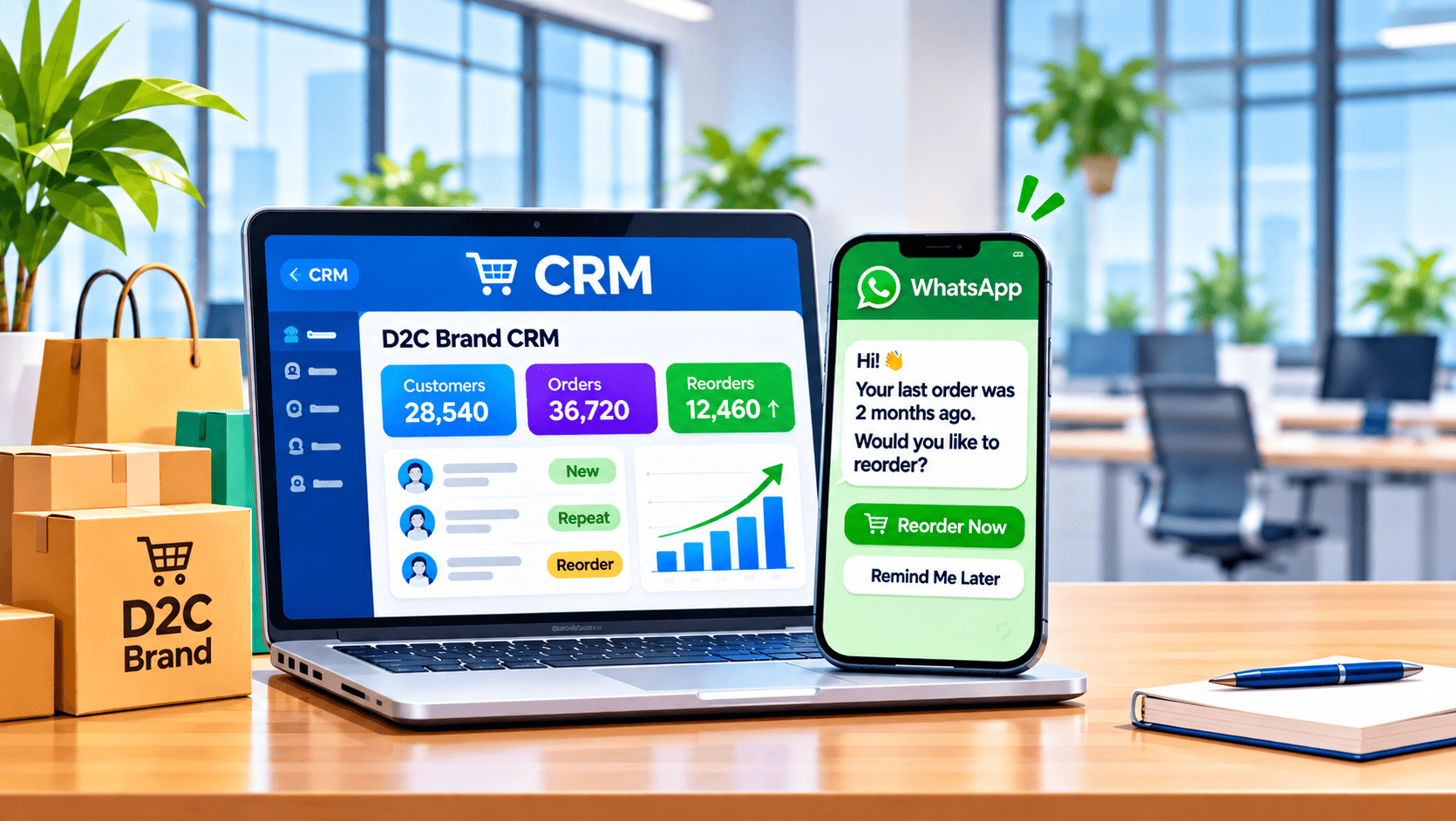
Indian D2C founders know the uncomfortable maths: acquiring a customer through Meta or Google ads is expensive, and the first order rarely pays back that cost on its own. Profit comes from the second, third and fourth orders. Yet many brands treat every customer as a one-time sale, chasing new buyers while existing ones drift away. A CRM for D2C brands, India's WhatsApp-first buyers in mind, changes that by turning past customers into a reorder engine.
This guide focuses on one job: using WhatsApp broadcasting, retargeting and segmentation to bring customers back, while staying within WhatsApp's rules.
Table of contents
- Why reorders decide D2C profitability
- What a CRM for D2C brands India teams need
- Building a reorder calendar
- WhatsApp broadcasting and retargeting that customers welcome
- Segments every D2C brand should create
- Measuring reorder performance
- Hypothetical example: a coffee brand in Bengaluru
- How Wetroo helps
- FAQs
Why reorders decide D2C profitability
Paid acquisition costs rise as more brands compete for the same audiences. A returning customer, by contrast, already trusts you, knows the product and does not need an expensive ad to find you. Even a small improvement in repeat purchases can change unit economics.
The challenge is that marketplace-style email newsletters do not get much attention from many Indian consumers. WhatsApp does. Customers already use it to ask about orders, track deliveries and share products with family. That makes it the natural reorder channel, provided you use it with permission and restraint.
What a CRM for D2C brands India teams need
A D2C CRM is not the same as a B2B sales pipeline. Priorities differ:
| Need | Why it matters for D2C |
|---|---|
| Customer records with order history | Know what and when each customer bought |
| Opt-in tracking | Message only people who agreed |
| Segmentation by product, recency and value | Send relevant offers, not blasts |
| Official WhatsApp Business API | Scale messaging safely with templates |
| Broadcasting and retargeting | Reach segments at the right time |
| Shared inbox for replies | Turn broadcast replies into conversations |
| Automation and drips | Trigger reorder reminders automatically |
| Ad platform signals | Feed purchase data back to Meta where useful |
| Invoices | Close WhatsApp orders without extra tools |
Many D2C brands run their store on a platform like Shopify or WooCommerce. Your CRM should be able to receive customer and order data from it through an integration or webhook.
Building a reorder calendar
Most consumable products have a natural replenishment cycle. Map yours:
| Product type | Typical reorder trigger |
|---|---|
| Coffee, tea, snacks | When a pack is likely finishing |
| Skincare, haircare | When a bottle is likely running low |
| Supplements | Monthly or per pack size |
| Pet food | Based on pack size and pet size |
| Baby products | Frequent, by age stage |
| Home cleaning | Monthly |
Estimate the cycle from your own order data: the typical gap between first and second order for each product. Then schedule a reminder a few days before that point.
A simple reorder sequence
- Day 0: Order confirmation and delivery updates (utility messages)
- A few days after delivery: "How are you finding it?" with usage tips
- Just before the expected run-out: Reorder reminder with a one-tap link
- If no reorder after a week: A gentle second reminder or a related product suggestion
- If still no reorder: Move to a slower re-engagement segment
WhatsApp broadcasting and retargeting that customers welcome
Broadcasting means sending a message to many opted-in customers at once. Retargeting means sending messages to a segment based on past behaviour, such as people who bought once but not again.
Do it in a way customers value:
- Opt-in first. WhatsApp's Business Messaging Policy requires permission before you message people. Capture it at checkout and in click-to-WhatsApp conversations.
- Relevance over reach. Send coffee subscribers a coffee message, not a skincare sale.
- Fewer, better messages. Space out promotional broadcasts.
- Personalise. Name, last product, pack size.
- Make it easy to stop. Include an opt-out instruction and honour it.
- Know the costs. WhatsApp charges per delivered message by category and market at the time of writing; marketing messages cost more than utility ones. Check WhatsApp's pricing page.
Turn replies into sales
Broadcasts generate replies: "Is the 500 g pack available?", "Can I get COD?" Route them to a shared inbox where your team or an AI agent can answer quickly and close the order in the chat.
Segments every D2C brand should create
- First-time buyers (one order): nurture toward the second order
- Repeat buyers: early access and loyalty messages
- Lapsed customers: have not reordered beyond their normal cycle
- High-value customers: personal outreach from the founder or team
- Product-based segments: by category or SKU
- Cart or enquiry drop-offs: asked a question but did not buy
- Opted-out: never message for marketing
D2C reorder checklist
- Customer and order data flowing into CRM
- Opt-in captured and recorded
- Reorder cycle estimated per product
- Automated reorder reminders scheduled
- Segments for first-time, repeat, lapsed and high-value customers
- Promotional broadcasts spaced and personalised
- Replies handled in a shared inbox
- Opt-outs honoured automatically
Mistakes D2C brands make on WhatsApp
- Treating WhatsApp like email. Long promotional messages with many links get ignored or blocked. Keep it short and personal.
- Using one segment for everything. "All customers" is not a segment.
- Discounting every reminder. If every reorder message carries a coupon, customers learn to wait for it. Lead with convenience, use offers selectively.
- Ignoring replies. A broadcast that generates questions nobody answers for hours damages trust. Staff the inbox, or use an AI agent with a human fallback, before you hit send.
Measuring reorder performance
Track a few numbers monthly:
- Repeat purchase rate: share of customers who ordered more than once
- Time to second order
- Revenue from WhatsApp campaigns versus message costs
- Opt-out and block trends after each broadcast
- Reply rate on reorder reminders
If opt-outs rise, reduce frequency or improve relevance before sending more.
Hypothetical example: a coffee brand in Bengaluru
Illustrative scenario only, not a real brand.
A small Bengaluru coffee brand sells 250 g and 500 g packs through its website. It sent the same promotional message to every customer every week, and block rates were climbing.
The brand connects its store to a CRM, records opt-in at checkout and segments customers by pack size and last order date. Customers with a 250 g pack receive a reorder reminder sooner than those with 500 g. Lapsed customers get a single message offering a new roast, not weekly blasts. Replies go to a shared inbox where one team member handles grind and delivery questions. The founder watches repeat purchase rate and opt-outs every month, and promotional broadcasts drop to twice a month for engaged segments only.
How Wetroo helps
Wetroo serves B2B and D2C businesses and supports the official WhatsApp Business API with broadcasting and retargeting, drip campaign automation, sales sequences and rule-based workflows. Lead and customer tagging, search and filters let you build segments, and webhooks plus 100+ integrations help bring in data from other tools.
The omnichannel inbox handles replies from WhatsApp, Instagram, Facebook and Telegram in one place, and AI agents can answer, qualify and follow up 24/7. Wetroo also supports Meta Conversions API sync, invoices and quotations, and chatbots in English and several Indian languages.
FAQs
Why do D2C brands need a CRM?
To store customer and order history, segment buyers and automate reorder reminders and campaigns, instead of relying only on paid ads for every sale.
Is WhatsApp marketing allowed for D2C brands in India?
Yes, when you message opted-in customers through official channels and follow WhatsApp's policies.
How often should a D2C brand send WhatsApp broadcasts?
Base it on relevance and engagement. Reorder reminders follow product cycles; promotional broadcasts should be spaced out and segmented.
What is WhatsApp retargeting?
Sending targeted messages to customers based on past behaviour, such as previous purchases or enquiries, to bring them back.
Conclusion
A CRM for D2C brands, India-style, puts WhatsApp at the centre of repeat revenue: opted-in customers, product-based reorder reminders, relevant segments and fast replies. Reorders cost far less than new customers, so this is where profitable growth starts. To set up broadcasting, retargeting and reorder automation, explore www.wetroo.com.



