


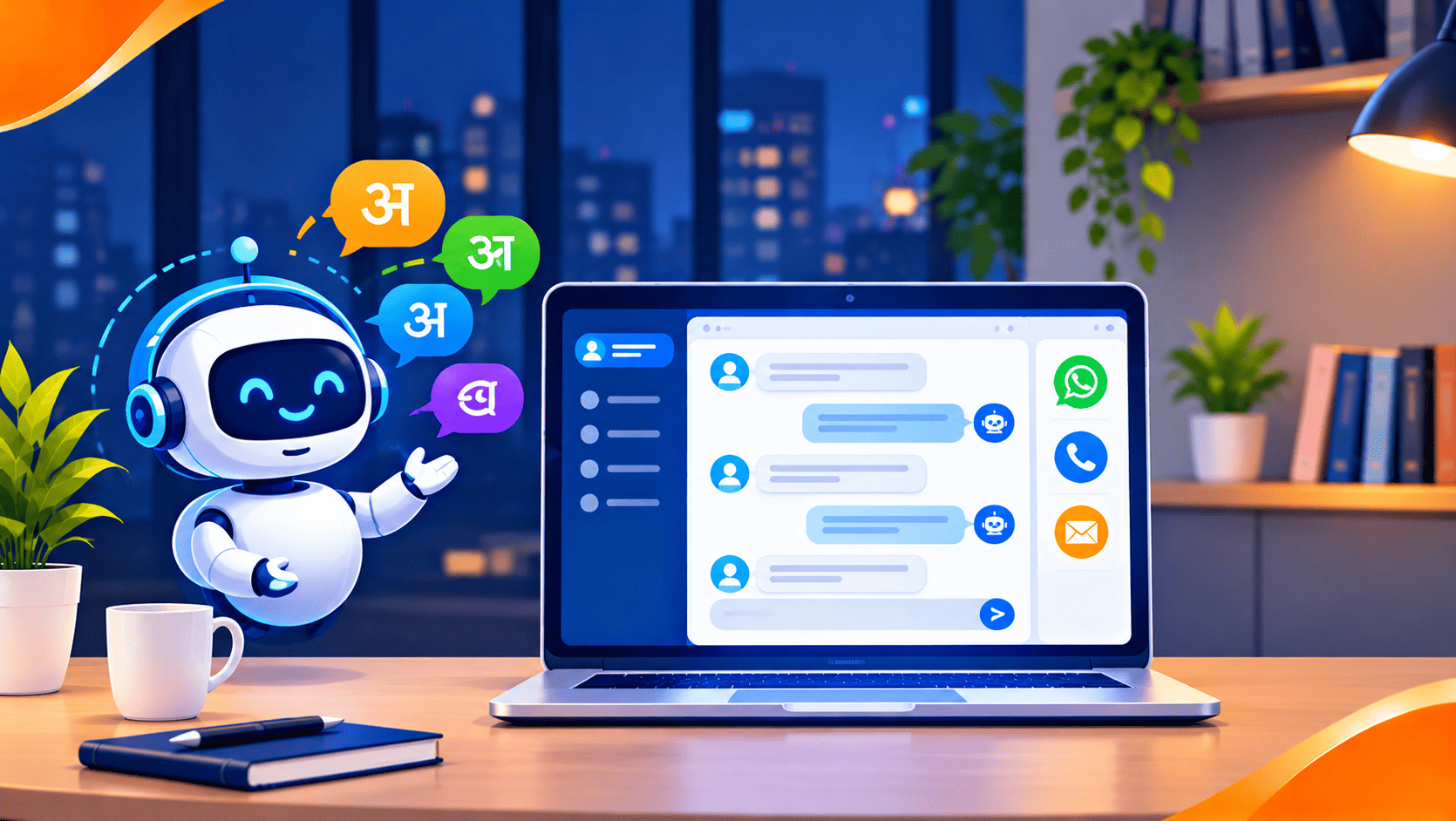
India's next wave of buyers is not waiting for you to speak English. A farmer in Vidarbha comparing drip irrigation kits, a parent in Madurai looking at coaching classes, a shop owner in Siliguri ordering stock: many of them are far more comfortable typing, or sending a voice note, in Marathi, Tamil or Bengali. A chatbot in Indian languages lets your business answer these customers instantly, in the language they think in, at any hour. Done well, it does not replace your sales team; it gets the conversation started and qualified so your people can close it.
This guide covers why language matters in sales, how to design multilingual chatbot flows, and where AI chat fits alongside scripted bots.
Table of contents
- Why language changes conversion
- What a chatbot in Indian languages can do for sales
- Designing multilingual chatbot flows
- Scripted bots vs AI chat agents
- Deploying on WhatsApp and other channels
- Choosing which languages to launch first
- Measuring results by language
- Hypothetical example
- How Wetroo helps
- FAQs
- Conclusion
Why language changes conversion
India's linguistic diversity is well documented by the Census of India (censusindia.gov.in), and anyone who has sold outside the metros knows its practical effect: people trust businesses that speak to them comfortably. In sales, language affects:
- Comprehension: customers understand product details, terms and prices more clearly.
- Confidence: they ask questions they would hesitate to ask in English.
- Speed: replies come faster when people do not have to translate in their heads.
- Trust: a familiar language signals that the business understands their context.
An English-only bot can quietly filter out a large part of your potential market.
What a chatbot in Indian languages can do for sales
Greet and route
Ask the customer's preferred language at the start, then continue entirely in that language.
Qualify
Collect the essentials: product interest, budget range, location, timeline. Store answers in your CRM.
Answer common questions
Prices or price ranges, batch timings, delivery areas, documents needed, showroom location.
Book the next step
Schedule a call, demo, site visit or showroom appointment.
Hand over to a human
When the customer is ready or asks something complex, transfer to a salesperson who speaks the same language, with the full conversation visible.
Designing multilingual chatbot flows
Start with a language menu
"Namaste! Please choose your language / ???? ???? ?????:
1. English 2. ????? 3. ????? 4. ????? 5. ??????"
Remember the choice on the lead record so future messages and calls use the same language.
Write natively, don't just translate
Machine translation of English scripts often sounds stiff. Have a native speaker write or review each flow. Use everyday words customers actually use, which may include English terms such as "EMI", "booking" or "site visit".
Keep messages short
Two or three lines per message, with buttons or numbered options wherever possible.
Support Hinglish and mixed scripts
Many users type Hindi in Roman script ("mujhe 2BHK chahiye"). Your bot should handle both Devanagari and Roman input where possible.
Plan for voice notes
Some customers prefer to send voice messages. Make sure a human or capable AI can respond appropriately rather than ignoring them.
| Flow step | English example | Hindi example |
|---|---|---|
| Greeting | "Hi! How can we help you today?" | "??????! ?? ???? ???? ??? ?? ???? ????" |
| Qualify | "Which product are you interested in?" | "?? ??? ???????? ??? ???? ???? ????" |
| Budget | "What budget range suits you?" | "???? ??? ????? ???" |
| Next step | "Shall we call you today?" | "???? ?? ?? ???? ??? ?????" |
Scripted bots vs AI chat agents
| Aspect | Scripted chatbot | AI chat agent |
|---|---|---|
| How it works | Fixed menus and buttons | Understands free text and context |
| Best for | Simple qualification, FAQs, booking | Open questions, varied phrasing, follow-ups |
| Language handling | Each flow written per language | Can respond across languages with good prompts |
| Control | Very predictable | Needs guardrails and review |
| Setup effort | Build each path | Provide knowledge and rules |
Many businesses use both: a scripted bot for the opening menu and structured questions, and an AI agent for open-ended conversations, with a human always available.
Guardrails for AI chat
- Give it approved information: prices, policies, FAQs.
- Instruct it not to make promises it cannot keep (discounts, approvals, delivery dates).
- Define clear handover triggers: pricing negotiation, complaints, a request for a person.
- Review a sample of conversations weekly in each language.
Deploying on WhatsApp and other channels
WhatsApp is the natural home for vernacular chatbots in India. On the WhatsApp Business API, when a customer messages you, a 24-hour customer service window opens in which your replies, including bot replies, count as service messages. Under Meta's pricing effective 1 October 2026, each business number gets 1,000 free service messages a month, after which they are charged; business-initiated messages need approved templates and are charged per delivered message (Meta pricing documentation). Click-to-WhatsApp ads are a popular way to start such conversations.
The same flows can also run on Facebook Messenger, Instagram DMs and your website chat, so customers get a consistent experience across channels.
Multilingual chatbot checklist
- Language menu at start, preference saved to CRM
- Flows written or reviewed by native speakers
- Roman-script Hindi handled
- Qualifying questions mapped to CRM fields
- Human handover by language
- AI guardrails and weekly review
- Opt-out respected
Choosing which languages to launch first
Supporting eight languages on day one is rarely necessary. Prioritise based on evidence:
- Look at your existing chats and calls. Which languages do customers already use when they message or call? Your team's experience is the best starting signal.
- Map your ad targeting. If campaigns run in Gujarat and Maharashtra, Gujarati and Marathi are natural first choices alongside Hindi and English.
- Check team coverage. Launch a language only when you have at least one person who can take over conversations in it. A bot that qualifies a lead in Telugu and then hands over to someone who cannot speak Telugu creates frustration.
- Start with your highest-volume flow. Usually this is the new-enquiry qualification flow. FAQs and post-sale flows can follow.
A practical sequence for many businesses is English and Hindi first, then one or two regional languages tied to their strongest markets, then expansion as the team grows. Each new language should have its own owner who reviews conversations and updates wording.
Measuring results by language
Track these metrics separately for each language:
- Conversations started and completed
- Qualified leads produced
- Handover rate to humans
- Appointments or calls booked
- Conversion to sale
You may find, for example, that Marathi conversations convert better but need more human handovers, which tells you to hire or train a Marathi-speaking closer.
Hypothetical example
This is a hypothetical example for illustration, not a real customer.
A two-wheeler dealership group in Tamil Nadu runs click-to-WhatsApp ads in Tamil and English. Previously, all chats were answered by two English-speaking staff during showroom hours. The group sets up a bot that opens with a language menu, asks model interest, budget and preferred showroom, and offers test-ride slots, in Tamil and English. An AI agent handles follow-up questions such as EMI options in general terms, and hands over to Tamil-speaking sales staff for pricing discussions. Evening and Sunday enquiries now receive an instant reply and a test-ride booking request.
How Wetroo helps
Wetroo's verified capabilities for multilingual sales include:
- Chatbot builder in English, Hindi, Marathi, Tamil, Telugu, Bengali, Gujarati and Kannada.
- AI agents that chat, call, qualify and follow up 24/7, with live transfer to a human.
- Omnichannel inbox across WhatsApp, Facebook, Instagram and Telegram.
- Official WhatsApp Business API with broadcasts and sequences.
- Teams and assignment rules to route conversations to salespeople who speak the customer's language.
- Lead tagging and analytics to measure results by segment.
FAQs
What is a chatbot in Indian languages?
It is an automated chat assistant that converses with customers in Hindi or regional languages such as Tamil, Telugu, Marathi, Bengali, Gujarati or Kannada, typically on WhatsApp, social media or a website.
Can a WhatsApp chatbot reply in Hindi?
Yes. With the WhatsApp Business API and a chatbot that supports Hindi, you can run full conversations in Hindi, including Devanagari and Roman script.
Should I use a scripted bot or AI chat for regional languages?
Use a scripted bot for structured qualification and booking, and AI chat for open questions, with clear guardrails and human handover.
Do customers really prefer regional languages for buying?
Many do, especially outside metros. Offer a choice and measure results by language for your own audience.
Conclusion
A chatbot in Indian languages opens your business to customers who would otherwise hesitate, or never reply. Start with a language menu, write natively, keep flows short, combine scripted and AI chat sensibly and always offer a human. Measure by language and invest where conversations convert.
To build multilingual chat for your sales funnel, explore Wetroo at www.wetroo.com.



