


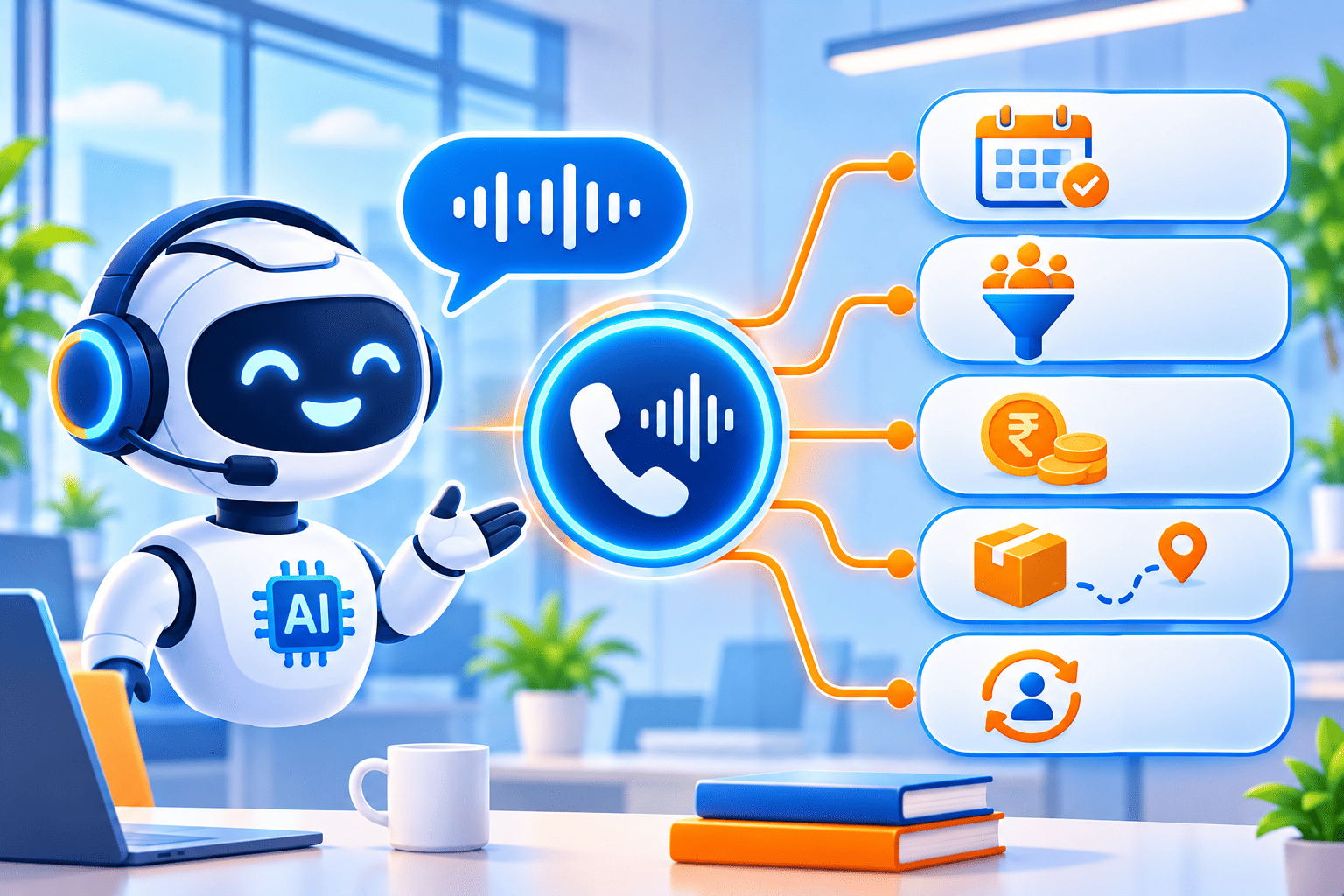
"Press 1 for sales. Press 2 for support. Press 9 to repeat this menu." Every Indian customer has heard some version of this, and most have pressed 0 repeatedly hoping to reach a human. Traditional IVR menus route calls, but they cannot understand what a caller actually wants. An AI voice bot for sales changes that. Instead of making callers fit your menu, it listens to natural speech, asks follow-up questions and acts on the answers. This guide explains the difference, the sales use cases where voice AI makes the most sense, and the limits to keep in mind.
Table of contents
- IVR menus vs an AI voice bot for sales
- Where voice AI fits in the sales funnel
- Seven practical use cases
- Designing a good voice conversation
- Limits and guardrails
- How Wetroo helps
- FAQs
- Conclusion
IVR menus vs an AI voice bot for sales
Interactive voice response (IVR) systems use pre-recorded prompts and keypad input to route calls (Wikipedia overview). They are reliable and still useful. But a caller cannot say "I want a 3BHK under 90 lakh near Wakad" to a keypad.
| Aspect | Push-button IVR | AI voice bot |
|---|---|---|
| Input | Keypad digits | Natural speech |
| Flexibility | Fixed menu tree | Follows the conversation |
| Data captured | Menu choices | Requirements, budget, timeline, preferences |
| Languages | Separate recorded menus | Can be configured for multiple languages |
| Outcome | Routes the call | Qualifies, books, routes or transfers |
| Best for | Simple routing at scale | Understanding intent and qualifying |
The two are not enemies. Many businesses keep a simple IVR for routing and add voice AI where conversation adds value. Our post on IVR for sales in India covers how missed calls and IVR feed a CRM.
Where voice AI fits in the sales funnel
Think of three stages where a voice bot can help:
- Top of funnel: answering or calling new enquiries immediately, especially outside office hours.
- Middle: qualifying interest, collecting requirements and scheduling the next step.
- Bottom: reminders, confirmations and simple post-sale check-ins.
Closing, negotiation and complex consultative selling remain human work.
Seven practical use cases
1. Instant callback on new web or ad leads
When someone fills a form, the voice bot calls within minutes: "Hi, this is the assistant from ABC Interiors. You asked about a modular kitchen. Is now a good time for two quick questions?"
2. Natural-language inbound qualification
Instead of "press 1 for new homes", the bot asks, "What are you looking for today?" and understands "I want to visit the Baner project this weekend."
3. After-hours coverage
Calls and leads that arrive at night are answered rather than going to voicemail. See our guide to after-hours lead response.
4. Appointment booking and confirmation
The bot offers slots for a site visit, demo or consultation and confirms the booking, then sends details over WhatsApp or SMS.
5. Re-engaging dormant enquiries
Leads who enquired months ago and did not opt out can be asked whether they are still interested, within applicable consent rules.
6. Event and webinar reminders
A quick call before a webinar or open house reminds registrants and confirms attendance.
7. Smart routing to the right salesperson
Based on what the caller says (language, product, city), the bot transfers them to the most suitable human.
Hypothetical example
This is a hypothetical example, not a real customer. "Metro Auto World", a multi-brand used-car dealer in Chennai, used a three-level IVR for its showroom number. Callers who wanted a specific model often hung up in the menu. The dealer adds an AI voice bot that asks, in Tamil or English, what the caller is looking for. A caller says, "Do you have a 2021 Creta diesel under 12 lakh?" The bot collects budget, preferred model and visit day, logs everything to the CRM and transfers the caller to the available sales executive, who already knows what the customer wants before saying hello.
Designing a good voice conversation
Voice is less forgiving than chat. Keep these principles in mind:
Voice bot design checklist
- Introduce the business and purpose in the first sentence
- Ask one question at a time
- Keep the call short; collect only what the salesperson needs
- Confirm key details back ("So that's a 2BHK in Kharadi, correct?")
- Offer the caller's preferred language
- Always offer a human: "Would you like to speak to our team now?"
- End with a clear next step and send it on WhatsApp or SMS
- Log the transcript or summary to the CRM
Script tips for Indian callers
Callers often mix languages ("Mujhe 2BHK chahiye, budget around 80 lakh"). Test your bot with Hinglish and regional-language phrasing. Use plain words, avoid jargon, and allow for interruptions, which are normal in real conversations.
Measuring whether the bot is working
Track a few simple indicators from week one: how many calls the bot answered or placed, how many reached the end of the script, how many were transferred to a human, and how many of those transfers turned into a site visit, demo or order. Also listen to a sample of calls where callers hung up early. These usually reveal a confusing question, an overly long introduction or a language mismatch. Small script changes, such as shortening the opening line or asking about budget later in the call, often make a noticeable difference. Treat the bot like a new team member who needs coaching, not a machine you switch on once and forget.
Limits and guardrails
An AI voice bot for sales is powerful but not magic.
- Accuracy varies with background noise, network quality and accents. Plan fallbacks.
- Do not make promises the bot cannot keep, such as final prices or guaranteed approvals.
- Avoid advice in regulated categories like medical diagnosis or financial guarantees.
- Follow calling regulations. For outbound commercial calls, TRAI's 2025 amendment designates the 140 series for promotional and 1600 series for transactional and service calls, and requires disclosure of auto-dialer or robo-call use (TRAI).
- Review recordings regularly to improve the script and catch errors.
How Wetroo helps
Wetroo includes voice AI inside its CRM. Its AI agents can chat, call, qualify and follow up 24/7, and AI calling supports live transfer to a human, so callers reach a person when they are ready. Alongside that:
- IVR and SIM-based calling support your human team, and an unlimited IVR add-on is listed on Wetroo's pricing page for annual plans.
- Leads from Facebook, Instagram, Google Ads lead forms, IndiaMART and WordPress forms flow in automatically for instant callbacks.
- The client timeline, notes and follow-up reminders mean salespeople see what the bot learned.
- WhatsApp Business API, SMS and email follow up after the call with booking details.
- For text conversations, the chatbot builder supports English, Hindi, Marathi, Tamil, Telugu, Bengali, Gujarati and Kannada. Our post on the AI chat agent for sales covers that side.
FAQs
What is the difference between IVR and an AI voice bot?
IVR uses recorded menus and keypad input to route calls. An AI voice bot understands natural speech, asks questions and can qualify, book or transfer based on what the caller says.
Can an AI voice bot speak Hindi and regional languages?
Many voice AI systems can be configured for Hindi and other Indian languages. Test with real callers, including mixed-language speech, before going live.
Will an AI voice bot replace my sales team?
No. It handles repetitive first conversations and routing. Humans remain essential for negotiation, relationships and closing.
Is it okay to use a voice bot for outbound calls?
Outbound commercial calls are regulated by TRAI. Start with inbound and enquiry-based callbacks, and confirm compliance with your telecom provider for anything promotional.
How long does it take to set up an AI voice bot?
A simple qualification flow with a few questions can usually be drafted and tested quickly, especially if your lead sources are already connected to the CRM. Plan extra time for testing languages, writing transfer rules and reviewing the first few days of recordings before scaling up.
Conclusion
An AI voice bot for sales goes beyond IVR menus by understanding what callers actually say and turning it into qualified, routed leads. Start with instant callbacks and inbound qualification, design short and polite conversations, and always provide a path to a human. To see AI calling with live transfer working inside a CRM, visit www.wetroo.com.



