


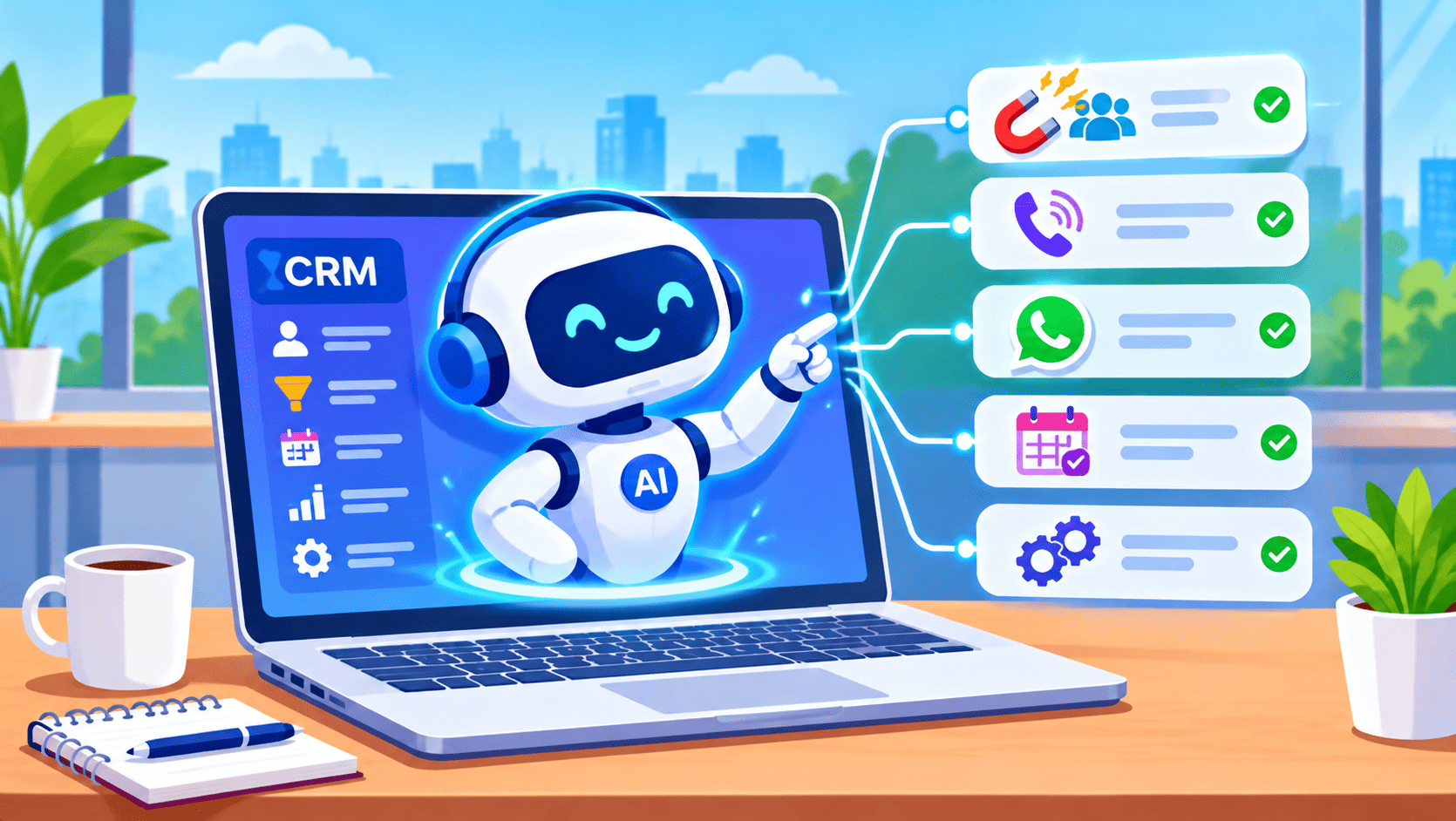
For two decades, a CRM was a place to store things: contacts, deals, notes, tasks. It was only as useful as the people who updated it, which is why so many CRMs ended up half-empty. Then came "AI-powered" CRMs that could summarise calls or suggest the next best action. Now a new phrase is everywhere: agentic CRM. The idea is simple to say and important to understand. An agentic CRM does not just record and recommend; it acts. It replies to the lead, makes the call, books the visit and schedules the follow-up, within rules you set. This guide explains what agentic CRM means, how it differs from AI-powered CRM, what it looks like in daily sales work, and where its limits are.
Table of contents
- Agentic CRM meaning in one paragraph
- Three generations of CRM
- Agentic vs AI-powered CRM: the real difference
- What an agentic CRM does in a sales day
- What makes an agent trustworthy
- How to evaluate an agentic CRM in a trial
- Limits and risks to understand
- A hypothetical example
- How Wetroo helps
- FAQs
- Conclusion
Agentic CRM meaning in one paragraph
An agentic CRM is a customer relationship management system in which AI agents pursue defined goals, such as "respond to every new lead and book qualified ones for a demo", by taking actions across channels and updating records themselves, with humans setting the rules, reviewing outcomes and taking over when needed. The word "agentic" comes from agency: the capacity to act, not merely to analyse.
Three generations of CRM
| Generation | What the CRM does | Who does the work |
|---|---|---|
| Record-keeping CRM | Stores contacts, deals and notes | People enter data and do every task |
| Automated or AI-powered CRM | Runs fixed workflows; AI suggests, scores, summarises | People act on suggestions; rules handle simple triggers |
| Agentic CRM | AI agents converse, decide next steps within limits and execute | Agents handle routine conversations and tasks; people handle judgement and closing |
Most businesses today sit somewhere between the first and second generations. Agentic CRM is the third.
Agentic vs AI-powered CRM: the real difference
The difference is not whether AI is present. It is who acts.
- An AI-powered CRM might tell a salesperson, "This lead looks hot; call within 10 minutes." The salesperson still has to call.
- An agentic CRM calls the lead itself, asks qualifying questions, books a slot and assigns the lead to the salesperson with a summary.
Another way to see it:
- Rule-based automation follows a fixed path: "If a lead arrives, send template A."
- An agent works toward a goal and adapts: "The lead asked about EMI, so share the EMI options, then ask about timeline, then offer a call."
Agentic systems usually combine both: dependable rules for things that must always happen, and agents for conversations that need flexibility. See our guide to workflow automation in a CRM for the rules side.
What an agentic CRM does in a sales day
Imagine a normal day for a 10-person sales team:
- Overnight: leads from ads and marketplaces receive replies within seconds. The agent answers questions, qualifies and books morning callbacks.
- Morning: salespeople open a list of qualified, time-stamped leads with summaries instead of a pile of unread messages.
- Midday: the agent calls new form leads within minutes, transfers hot ones live and sends WhatsApp brochures to warm ones.
- Afternoon: the agent follows up on quotations sent two days ago and reschedules missed demos.
- Evening: the CRM shows what the agents did, what humans did, and what is stuck.
Signs a CRM is genuinely agentic
- It can hold two-way conversations on chat and/or voice
- It takes actions, not just suggestions: books, sends, assigns, updates
- It works toward goals you define, such as qualify or book
- It knows when to hand over to a human, with context
- Every action is logged and reviewable
- You can set boundaries on what it may say, promise or share
What makes an agent trustworthy
An agent that acts on your behalf must be held to a high standard:
- Grounded knowledge. It answers from your approved information, such as prices, policies and FAQs, not guesses.
- Clear boundaries. It never offers discounts it is not allowed to, never asks for sensitive data, never promises delivery dates without confirmation.
- Transparent handoff. Customers can reach a person easily.
- Auditability. You can read every conversation and see every action.
- Channel compliance. For example, on WhatsApp it respects the 24-hour customer service window and uses approved templates outside it, as Meta's documentation describes.
How to evaluate an agentic CRM in a trial
Demos are designed to impress. A trial with your own leads tells the truth. During a two-week pilot, test these things deliberately:
- Ask awkward questions the agent has not been trained on and see whether it admits uncertainty or invents an answer.
- Request a human midway through a chat and a call, and time how quickly one appears.
- Change a price in your approved information and check that the agent uses the new figure the same day.
- Read the logs for ten conversations and confirm every action, such as a booking or tag, appears correctly on the lead record.
- Compare outcomes for agent-handled leads and human-only leads on the same campaign.
If a vendor cannot support this kind of trial, treat that as a signal.
Limits and risks to understand
Agentic CRM is powerful, but not magic:
- Garbage in, garbage out. Poor FAQs or outdated prices lead to wrong answers at scale.
- Over-automation. Customers notice when every message feels scripted. Keep personal touches where relationships matter.
- Edge cases. Complaints, legal questions and complex custom deals belong with people.
- Change management. Teams need to trust the agent's work, which comes from reviewing it together in the early weeks.
- Cost awareness. AI usage and messaging have costs; track them against results.
The healthiest mindset: the agent is a tireless junior teammate who handles first contact, routine questions and follow-ups, supervised by your team.
A hypothetical example
Illustrative scenario, not a real business.
A coaching institute in Kota runs ads for its foundation programme. With a record-keeping CRM, counsellors manually called each lead the next day. With an AI-powered CRM, they got a "hot lead" score but still called manually. With an agentic CRM, a parent who fills a form at 10 pm receives a WhatsApp reply in Hindi within seconds; the agent answers questions about batch timing and hostel options, asks the student's class and target exam, and books a counselling call for 11 am. The counsellor opens the day with the summary, and the agent follows up after the session with the fee structure. Counsellors review a sample of agent conversations every Friday.
How Wetroo helps
Wetroo describes itself as an agentic CRM built for SMEs, MSMEs and solopreneurs. Its AI agents work 24/7, chatting, calling, qualifying and following up, with AI calling that can transfer live to a human. The agents sit on top of a full CRM: lead capture from Facebook Ads, Instagram, Google Ads lead forms, IndiaMART and WordPress forms; an omnichannel inbox on the official WhatsApp Business API; custom assignment rules for teams and sub-teams; and sales sequences, drip campaigns and a no-code workflow builder for rules that must always run.
FAQs
What does agentic CRM mean?
It means a CRM where AI agents take actions toward sales goals, such as replying, calling, qualifying and booking, rather than only storing data or making suggestions.
Is agentic CRM the same as AI CRM?
Not exactly. Many AI CRMs suggest or summarise. An agentic CRM acts on its own within rules you set.
Do agentic CRMs replace salespeople?
No. They take over repetitive first contact and follow-ups so salespeople focus on conversations that need judgement and relationships.
Is agentic CRM suitable for small businesses?
Yes. Small teams often benefit most because they cannot staff every channel around the clock.
Conclusion
Agentic CRM marks a shift from software that remembers to software that acts. Instead of reminding your team to reply, it replies; instead of scoring leads, it qualifies and books them, then hands over with context. Choose a system with clear boundaries, full logs and easy human handoff, and review its work regularly. To see what a CRM that acts looks like for Indian SMEs, explore www.wetroo.com.



